
Book Appointment Now
Structured Cabling and Network Wiring for Dental Offices
Structured Cabling and Network Wiring for Dental Offices. Expert insights from GCMM Dental Construction. Call (347) 961-7357 for your project.
Structured Cabling and Network Wiring for Dental Offices
Looking for structured cabling dental offices? If you’re planning a dental office buildout or renovation, structured cabling is one of the most consequential decisions you’ll make — and one of the most commonly underestimated. We’ve seen it happen dozens of times across projects in the Bronx, Queens, Long Island, and New Jersey: a dentist moves into a beautifully finished space only to discover that the network infrastructure wasn’t designed for a modern clinical environment. Digital sensors don’t reach the chair. The CBCT machine can’t connect to the server. Intraoral cameras drop signal mid-appointment. Fixing these problems after drywall is installed costs far more than doing it right the first time.
Professional Structured Cabling Dental Offices
At GCMM Dental Construction, we design and install structured cabling systems purpose-built for dental practices. Our team understands that a dental office network isn’t just an office network — it’s a clinical tool that directly affects patient care, workflow efficiency, and the performance of expensive diagnostic equipment. This guide walks through every component of a properly engineered dental office cabling system, from the wiring closet to the individual operatory drops.
Why Structured Cabling Must Be Planned Before Drywall
The single most important principle in dental office network infrastructure is this: cable routing decisions must happen before framing is closed. Once drywall goes up, your options shrink dramatically. Running conduit after the fact often means exposed surface-mounted raceways, which look unprofessional and can violate infection control standards in clinical areas. In some cases, cables need to pass through fire-rated assemblies, which require proper firestop materials and inspections — tasks that are significantly more disruptive after construction is complete.
Our structured cabling dental offices team specializes in creating functional, code-compliant spaces tailored to your practice.
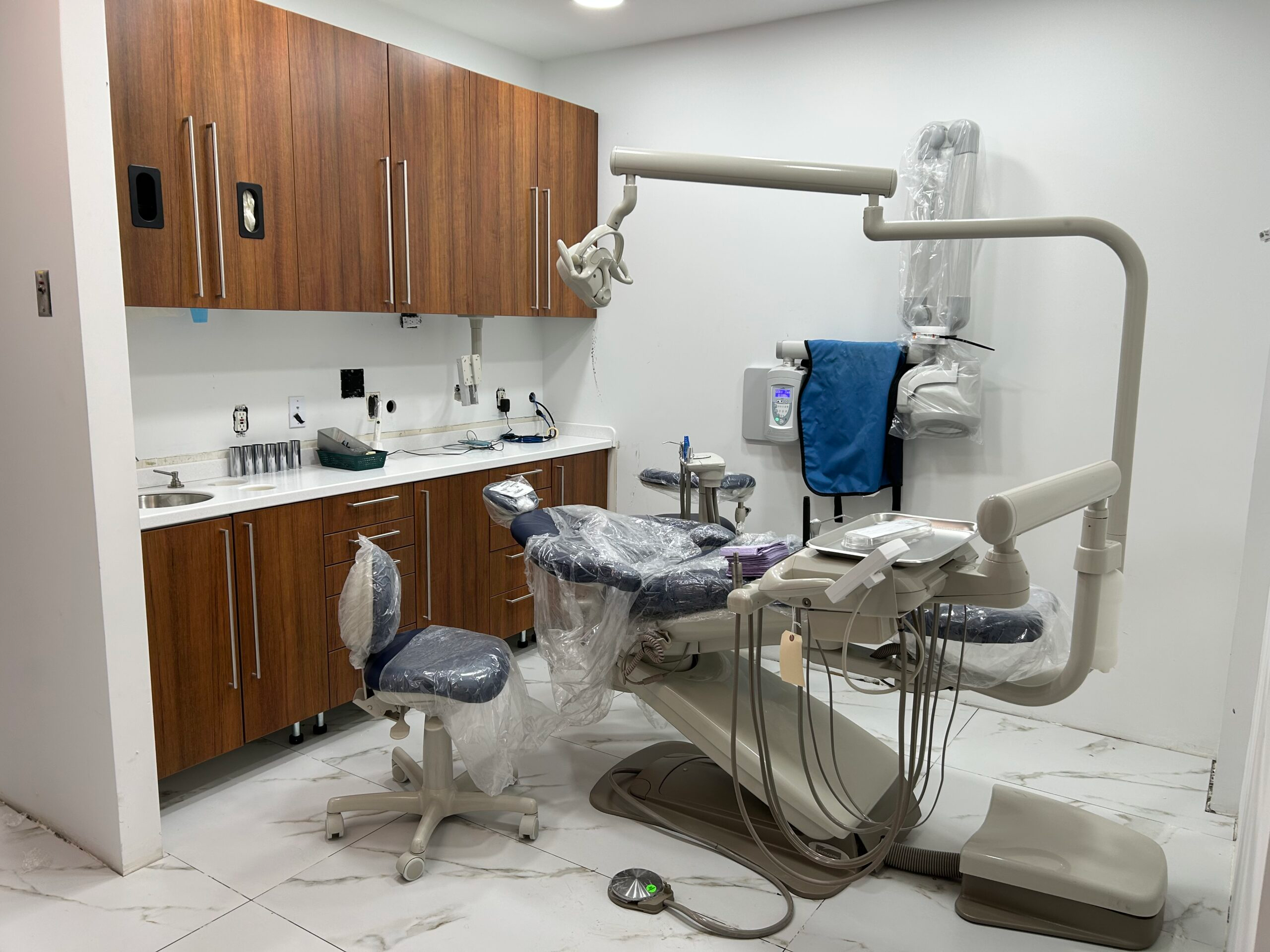
We coordinate structured cabling planning during the schematic design phase, typically working alongside the dental equipment vendor, the IT consultant, and the architect simultaneously. Chair positions, cabinetry layouts, monitor mounting locations, and sensor storage all inform where cable drops need to land. This isn’t guesswork — our team uses confirmed equipment specifications and floor plan dimensions to map every run before a single hole is drilled.
For our projects in Westchester and Connecticut, where building departments often require detailed MEP drawings for permit approval, having a documented cabling plan also streamlines the permitting process. You can explore how we handle dental office electrical cabling in tandem with low-voltage structured wiring to understand how these systems are coordinated on the same project timeline.
wp:image {“id”:1224}
/wp:image
Cat6A Cabling for Every Operatory: Why It Matters
The backbone of any modern dental office network is the horizontal cabling that runs from the structured wiring closet to each operatory. We specify Cat6A (augmented Category 6) cable as the minimum standard for new dental office buildouts. Here’s why this matters in practical terms:
- 10-Gigabit capable: Cat6A supports 10GbE at full 100-meter runs, which provides headroom for high-resolution imaging data, including large CBCT files that can exceed 500MB per scan.
- Superior shielding: Cat6A’s larger diameter and improved alien crosstalk mitigation perform better in environments with high electromagnetic interference — and dental offices have significant EMI sources including x-ray generators, electric handpieces, and ultrasonic scalers.
- Future-proofing: A dental office built today should have cabling infrastructure that doesn’t need replacement for 15 to 20 years. Cat6A gives you that runway.
- PoE+ compatibility: Power over Ethernet Plus devices — including IP cameras, access points, and digital signage — require Cat6A for reliable power delivery at distance.
In a typical 6-operatory dental office, we run a minimum of four Cat6A drops per operatory: one for the primary workstation, one for the dental unit controller or chair-mounted display, one for the intraoral camera or digital sensor receiver, and one spare for future equipment. High-end practices with ceiling-mounted monitors, chairside tablets, and multiple imaging devices may require six or more drops per room.
Digital Sensor Wiring and Intraoral Camera Drops
Digital radiography sensors and intraoral cameras have specific cabling requirements that differ from standard data drops. USB-connected sensors — including Dentsply Sirona’s XIOS and Carestream’s RVG series — require the workstation to be positioned within USB signal range, typically no more than 5 meters without a powered hub. This influences where the PC is mounted relative to the chair.
For intraoral cameras, most modern systems use USB 3.0 connections, which are sensitive to cable length and routing. When cabinetry positions the camera docking station more than 3 meters from the computer, we install USB 3.0 active extension cables within dedicated conduit, properly routed to avoid interference with high-voltage dental unit wiring. The conduit separation between data and power isn’t optional — it’s an NEC requirement and a clinical necessity.
We also plan sensor storage locations in coordination with the cabinetry vendor. Many practices in our New Jersey and Long Island projects use Midmark or A-dec cabinetry with integrated cable management channels. As a Midmark and A-dec manufacturer-trained contractor, our team knows exactly how these systems route cables internally and where the termination points need to land in the wall cavity behind the cabinet run.
wp:image {“id”:1261}
/wp:image
CBCT Network Integration: High-Demand Infrastructure Requirements
Cone beam computed tomography (CBCT) units represent one of the most demanding network infrastructure requirements in a dental office. Systems like the Planmeca ProMax, Carestream CS 9600, or Dentsply Sirona Orthophos S generate large 3D image files that must be transferred to a local server or cloud workstation quickly and reliably. A slow or unstable network connection creates workflow bottlenecks and — in the case of an interrupted transfer — potential image loss.
For CBCT room integration, we specify a dedicated Cat6A run direct from the wiring closet to the imaging unit — never daisy-chained through a switch in the operatory or shared with other high-demand devices. The CBCT room also requires coordination with the electrical team for the unit’s dedicated 20-amp circuit, lead lining installation, and proper grounding. As Planmeca manufacturer-trained installers, we’ve coordinated this process across multiple NYC and Westchester imaging suites, working directly with the equipment vendor’s install team to ensure network handoff meets the manufacturer’s specifications.
If your practice is planning a CBCT installation, this is an area where our structured cabling for dental office renovations experience is particularly valuable — because retrofitting a CBCT room into an existing space requires careful coordination of shielding, electrical, and network systems that were never designed with that equipment in mind.
Structured Wiring Closet Design for Dental Offices
Every multi-operatory dental office needs a properly designed telecommunications room or wiring closet — sometimes called an IDF (Intermediate Distribution Frame) in smaller practices. This is where all horizontal cabling terminates and where your core network equipment lives: patch panels, managed switches, firewall/router, UPS battery backup, and potentially a NAS (network-attached storage) device for local image archiving.
In dental offices, the wiring closet has requirements beyond what you’d find in a standard commercial office:
- Dedicated cooling: Network equipment generates heat, and a closet with inadequate ventilation leads to equipment failure and shortened hardware lifespan. We design ventilation or supplemental cooling into closet specifications from the start.
- UPS sizing: A dental practice cannot afford network downtime mid-procedure. We size uninterruptible power supply units to keep critical network infrastructure running through short power events and allow for a graceful shutdown during extended outages.
- Cable management: Patch panels are labeled at termination and mapped to a physical document that lives in the closet. Every run is labeled at both ends. This isn’t just good practice — it’s essential for any future IT troubleshooting or expansion.
- Physical security: The wiring closet should be lockable and HIPAA-conscious. Network access to patient record systems must be physically controlled, not just firewalled.
- Adequate space: In smaller NYC suites where every square foot is premium, we work with architects to locate the wiring closet in a position that minimizes horizontal cable runs while remaining accessible for service.
wp:image {“id”:1260}
/wp:image
How GCMM Coordinates Cabling With Equipment Vendors
One of the most common failure points in dental office construction is the handoff between the general contractor and the equipment vendors. The GC finishes the space, turns it over, and then the dental equipment company arrives to find that conduit is in the wrong location, there aren’t enough drops, or the chair power connections are six inches short of the floor box. These are expensive, time-consuming problems that are entirely avoidable.
Our approach at GCMM is to function as the coordination hub between all vendors — not just a contractor who builds what’s on the drawings. We hold pre-construction coordination meetings that include the dental equipment vendor (A-dec, Midmark, Planmeca, or others), the IT/network consultant, the low-voltage cabling contractor, and the electrical subcontractor. We use those meetings to resolve conflicts before work begins, not during rough-in.
For a recent 8-operatory buildout in White Plains, our coordination process identified that the equipment vendor’s cabinetry layout required vacuum canister locations that conflicted with the originally planned data conduit routing. Catching that in coordination — rather than during installation — saved approximately three days of rework and avoided a change order that would have cost the owner several thousand dollars.
This is what distinguishes our team from general commercial contractors who occasionally take on dental work: we understand how dental equipment installs, not just how buildings are constructed. And it’s why we’re consistently recommended by dental equipment vendors across the New York metro area.
If you’d like to understand how cabling infrastructure fits into the broader scope of a full office build, our overview of dental chair installation from a contractor’s perspective covers how chair utility connections — including data, vacuum, air, water, and electrical — must be coordinated with rough-in work.
Frequently Asked Questions: Structured Cabling for Dental Offices
How many network drops does a dental operatory need?
A minimum of four Cat6A drops per operatory is standard for most practices: one for the primary workstation, one for the dental unit, one for imaging (intraoral camera or sensor), and one spare. Operatories with ceiling-mounted monitors, multiple imaging devices, or chairside tablets may require six or more drops. We assess your specific equipment list before finalizing the cabling plan.
Can I use Cat5e or Cat6 instead of Cat6A?
Cat5e is inadequate for new dental office construction — it maxes out at 1GbE and has no margin for the interference common in clinical environments. Cat6 is acceptable in smaller, lower-demand practices but lacks the alien crosstalk mitigation and 10GbE capability of Cat6A. For any practice running digital radiography, CBCT, or multiple simultaneous high-resolution imaging workstations, Cat6A is the right choice and the one we specify as our standard.
When does cabling get installed during construction?
Low-voltage cabling is installed during the rough-in phase, after framing and before insulation and drywall. This window is typically coordinated with electrical rough-in. Missing this window and attempting to run cables after drywall significantly increases labor costs and almost always results in compromise on cable routing quality.
Does GCMM handle the structured cabling directly or subcontract it?
We work with licensed low-voltage cabling contractors who are integrated into our project teams. We manage the scope, coordination, and quality control directly. The cabling plan is developed by our team in coordination with your equipment vendors and IT consultant, and we hold accountability for the result — not the subcontractor working in isolation.
Plan Your Dental Office Network Infrastructure with GCMM
Structured cabling is not the most glamorous part of a dental office buildout, but it’s one of the most consequential. Getting it right means your clinical technology works the way it’s supposed to from day one — and continues working reliably for the life of the practice. Getting it wrong means disruption, expense, and compromised workflows during what should be a smooth launch.
GCMM Dental Construction serves dental practices across NYC, Westchester, Long Island, New Jersey, and Connecticut. We are among the dental office contractors who include network infrastructure as a fully coordinated, planned component of every buildout — not an afterthought. Whether you’re building from ground up or renovating an existing space, our team brings the manufacturer training, construction expertise, and vendor coordination experience to do this right.
Contact us to schedule a pre-construction consultation for your dental office cabling project:
- Phone: (347) 961-7357
- Email: gary@gcmm.nyc
- Address: 876 Kinsella St, Bronx, NY
- Website: gcmmdentalconstruction.com
Serving dental offices in the Bronx, Manhattan, Brooklyn, Queens, Staten Island, Westchester, Long Island, New Jersey, and Connecticut.
GCMM Dental Construction is factory-trained by A-dec builds operatory rooms to exact equipment specifications. For general commercial construction, visit GCMM Home Improvement for commercial HVAC contractor. All designs comply with ADA dental office design guidelines.