
Book Appointment Now
Dental Office Contractors: Complete Guide 2026
Dental Office Contractors: Complete Guide 2026. Expert insights from GCMM Dental Construction. Call (347) 961-7357 for your project.
Dental Office Contractors: The Complete Guide to Building, Renovating, and Equipping Your Dental Practice
Table of Contents
- Introduction to Dental Office Contractors
- What Sets Dental Contractors Apart from General Contractors
- Core Services Dental Office Contractors Provide
- How to Evaluate and Hire a Dental Contractor
- Dental Office Buildout Process Step by Step
- ADA Compliance Requirements in Dental Construction
- Dental Equipment Installation and Manufacturer Training
- Plumbing and Utility Rough-In for Dental Offices
- Structured Cabling and Network Infrastructure
- CBCT and Imaging Room Construction Considerations
- Cost Breakdown for Dental Office Construction Projects
- Regional Considerations for NYC and the Tri-State Area
Introduction to Dental Office Contractors
Building or renovating a dental office is one of the most complex and capital-intensive projects a dentist will ever undertake. Unlike a retail space or standard medical office, a dental practice demands a precise convergence of plumbing, electrical, cabinetry, imaging infrastructure, network wiring, and specialized equipment installation — all working in harmony before a single patient walks through the door. That’s why dental office contractors exist as a distinct specialty, and why choosing the right one is one of the most consequential decisions you’ll make for your practice.
At GCMM Dental Construction, we’ve built and renovated dental practices across New York City, Westchester, Long Island, New Jersey, and Connecticut. We’re not a general contractor that occasionally takes on dental work — dental construction is all we do. This comprehensive guide is designed to help dentists, dental group owners, and DSO operators understand exactly what separates a qualified dental contractor from a generalist, what a full buildout or renovation actually involves, and how to avoid the expensive mistakes we see far too often in this industry.
Whether you’re opening your first practice in the Bronx, expanding a multi-location group across Nassau County, or renovating a 20-year-old office in Westchester, the information in this guide applies directly to your project. We’ve organized it to walk you through every phase, from initial evaluation through final punch list, so you can enter any contractor conversation as an informed client.
We also serve dentists as Dental Office Contractors NYC & Long Island | GCMM – GCMM Dental Office Construction, and our team is available to discuss your project at any stage. You can reach us directly at (347) 961-7357 or by email at gary@gcmm.nyc.
wp:image {“id”:1261}
/wp:image
What Sets Dental Contractors Apart from General Contractors
A general contractor can frame walls, install drywall, and lay flooring — but those skills represent only a fraction of what a dental office build demands. The moment you introduce a dental chair unit with integrated plumbing, a nitrous oxide delivery system, a CBCT scanner requiring radiation shielding, or a centralized compressor room with vacuum and air lines running through the ceiling, you are firmly in specialized territory.
Here’s what a true dental office contractor brings to the table that a general contractor simply cannot:
Knowledge of Dental-Specific Systems
Dental offices require centralized air compressors and vacuum systems, wet and dry vacuum lines, nitrous oxide piping with proper ventilation and scavenging systems, doctor and assistant cuspidor water lines, and high-voltage circuits for imaging equipment. A contractor who doesn’t understand these systems will coordinate poorly with your equipment vendor — and those coordination failures are exactly where projects go over budget and behind schedule.
Manufacturer Training and Certification
Our team at GCMM Dental Construction holds manufacturer training certifications from A-dec, Midmark, and Planmeca — three of the most widely specified dental equipment brands in the industry. This isn’t a marketing claim; it means our technicians have been trained directly by these manufacturers on how their equipment integrates into the physical space. Chair unit rough-in dimensions, cabinetry clearance tolerances, plumbing connection specifications, electrical load requirements — we know these details at the source level, which eliminates the guesswork that causes costly retrofits after installation.
Familiarity with Dental Building Codes
Dental offices fall under specific occupancy classifications in most jurisdictions, and they trigger requirements that don’t apply to standard commercial spaces — including infection control considerations for HVAC, plumbing backflow prevention, nitrous oxide ventilation requirements, and radiation shielding standards for X-ray and CBCT rooms. Navigating these code requirements in dense markets like New York City requires experience that general contractors rarely accumulate.
For a deeper comparison of what to look for when selecting between dental contractors, see our guide on how to compare dental construction companies.
Core Services Dental Office Contractors Provide
A full-service dental contractor handles far more than carpentry and drywall. Below is a breakdown of the primary service categories we manage at GCMM Dental Construction, which represents what any qualified dental contractor should be capable of delivering:
New Dental Office Buildouts
A ground-up or shell-space buildout involves transforming a raw commercial space into a fully functioning dental practice. This includes full design coordination, permitting, demolition (if needed), framing, MEP rough-in, finish work, cabinetry, equipment installation, and final inspections. Our full-service new dental office buildout scope covers every trade involved in getting a practice open from a blank canvas.
Dental Office Renovations
Renovation projects are often more complex than new buildouts because they require working around existing infrastructure, occupied adjacent spaces, and legacy systems that may not meet current code. A practice that opened in 2003 likely has plumbing and electrical layouts that predate modern equipment requirements. Our approach to dental office renovation projects and scope includes a thorough as-built assessment before any work begins.
Equipment Installation
We handle dental equipment installation by manufacturer-trained technicians, which includes dental chairs, delivery units, cabinetry, sterilization centers, panoramic X-ray units, CBCT scanners, intraoral sensors, and compressor/vacuum systems. Our manufacturer certifications mean we follow the exact installation protocols required to maintain equipment warranties.
Imaging and Radiology Room Construction
X-ray rooms and CBCT suites require radiation shielding that must be engineered and installed to meet state and local radiation control standards. This is non-negotiable and requires specific expertise in lead-lined wall construction and shielding calculations. See our detailed guide on CBCT and imaging room construction for a thorough breakdown of what’s involved.
Plumbing and Utility Infrastructure
Dental office plumbing is dramatically different from standard commercial plumbing. We manage dental office plumbing and utility rough-in, including chair unit water supply and drain lines, cuspidor connections, sterilizer plumbing, wet vacuum systems, and nitrous oxide piping with proper scavenging ventilation.
Structured Cabling and Network Wiring
Modern dental offices are technology-dense environments. Digital X-ray sensors, practice management software workstations, intraoral cameras, chairside monitors, and cloud-based imaging platforms all depend on a robust and properly designed network infrastructure. We handle structured cabling and data wiring for dental offices as an integrated part of every project, not an afterthought.
wp:image {“id”:1260}
/wp:image
How to Evaluate and Hire a Dental Contractor
The dental construction market includes everything from large national firms to local general contractors claiming dental experience. Understanding how to choose the right dental contractor requires knowing which questions to ask and what answers should raise red flags.
Questions to Ask Before Signing Any Contract
- How many dental offices have you built in the past three years? Look for a contractor with consistent, recent dental experience — not one that did a dental office five years ago among dozens of other project types.
- Are you manufacturer-trained on the equipment I’m specifying? If you’re installing A-dec, Midmark, or Planmeca equipment, your contractor should have formal training from those manufacturers. This protects your warranty and ensures correct installation.
- Do you self-perform or subcontract dental-specific trades? A contractor who subs out all plumbing, electrical, and equipment work has less control over quality and coordination than one who manages these trades directly with experienced dental subcontractors.
- Can you provide references from dental clients specifically? General construction references are not meaningful in this context. You want to speak with dentists who went through the same process you’re about to undergo.
- What is your permitting experience in this jurisdiction? In New York City, for example, permitting through the NYC Department of Buildings involves specific filing requirements that differ significantly from suburban jurisdictions in Westchester or New Jersey.
Reviewing Contractor References and Reviews
Beyond references, evaluating dental office contractor reviews and references should include looking for patterns in feedback — specifically around schedule adherence, communication quality, and how the contractor handles problems when they arise. Every project encounters unexpected conditions; the difference between a good contractor and a bad one is how they respond.
Red Flags to Watch For
- Extremely low bids that don’t account for dental-specific systems
- Vague scope of work documents with no line-item detail
- No mention of equipment coordination or manufacturer specifications
- Inability to explain radiation shielding requirements for imaging rooms
- No experience with the specific equipment brands you’ve purchased or are considering
Dental Office Buildout Process Step by Step
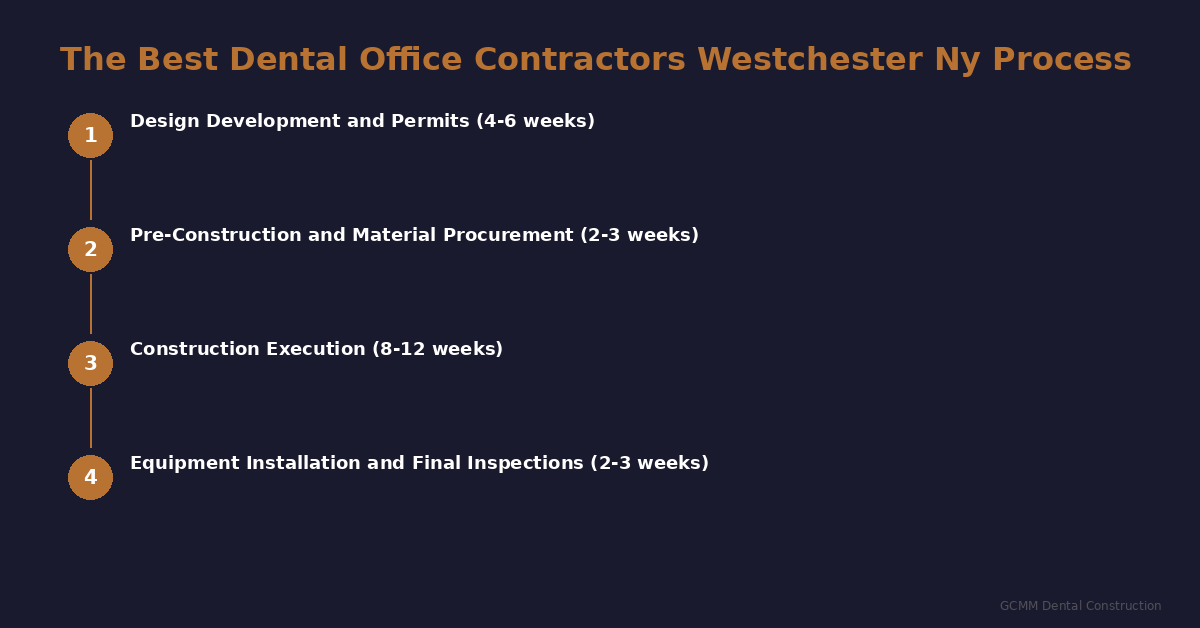
Understanding the construction process helps you manage expectations, communicate with your contractor, and make timely decisions that keep the project on schedule. Here’s how a typical dental office buildout unfolds at GCMM Dental Construction:
Phase 1: Pre-Construction Planning
Before a single nail is driven, we coordinate with your architect, equipment vendor, and landlord (for tenant improvement projects) to align the architectural plans with your equipment specifications. This is where we review dental chair rough-in sheets, plumbing fixture unit counts, electrical panel load calculations, and network topology. Decisions made — or deferred — at this stage have the greatest impact on project cost and schedule.
Phase 2: Permitting and Approvals
In New York City, permit filing for a dental office involves the Department of Buildings, potentially the Department of Health (for new practices), and in some cases the Landmarks Preservation Commission if the building is designated. In New Jersey and Connecticut, the process differs by municipality. We manage all permitting as part of our service, keeping projects moving without delays caused by administrative bottlenecks.
Phase 3: Demolition and Site Preparation
For renovation projects, selective demolition removes existing finishes, ceilings, and sometimes plumbing or electrical systems that no longer meet the new layout requirements. For shell-space buildouts, this phase involves site preparation, concrete cutting for under-slab plumbing if required, and layout confirmation against the approved plans.
Phase 4: MEP Rough-In
Mechanical, Electrical, and Plumbing rough-in is the most technically complex phase of any dental construction project. This is where chair unit water lines, vacuum lines, air lines, electrical circuits, data conduit, and HVAC are run through walls and ceilings before they’re closed up. Errors at this stage are expensive to correct after walls are finished, which is why coordination meetings and field verification against equipment specs are essential.
Phase 5: Framing, Drywall, and Finish Work
Once rough-ins pass inspection, walls are closed, taped, finished, and painted. Flooring is installed, ceilings are completed, and the space begins to look like a dental office.
Phase 6: Equipment Installation and Commissioning
This is the phase where our manufacturer training credentials matter most. Dental chairs, delivery units, cabinetry systems, sterilization centers, compressors, and imaging systems are installed and commissioned in sequence. We coordinate with your equipment vendors to ensure that our rough-in work meets their installation requirements precisely.
Phase 7: Inspections, Punch List, and Turnover
Final inspections cover building code compliance, electrical, plumbing, and in the case of imaging rooms, radiation safety compliance. After final inspections, we conduct a thorough punch list walkthrough with you to address any items before formal project turnover.
For a detailed breakdown of each phase with typical duration ranges, see our full guide on dental office construction timeline and phase breakdown.
ADA Compliance Requirements in Dental Construction
ADA compliance is not optional in dental construction — it’s a federal legal requirement, and it affects nearly every element of the built environment in a dental practice. Yet it’s one of the areas where we most frequently find deficiencies when evaluating or renovating existing practices, particularly those built more than 15 years ago.
Our approach to ADA compliance requirements in dental construction covers every applicable standard, but the most commonly relevant provisions for dental offices include:
Accessible Routes and Entrances
An accessible route must connect parking, public transportation stops, and the building entrance to every area of the practice that patients use. Door hardware must be operable with a closed fist (lever handles, not round knobs), and door widths must meet minimum clear-width requirements — typically 32 to 36 inches depending on approach angle.
Operatory Layout and Clearances
Patient transfer space around dental chairs, knee clearance at sinks, and turning radius requirements in treatment rooms must all be incorporated into the floor plan during design. We work with the architect and equipment vendor to ensure that operatory layouts accommodate both the clinical workflow and the ADA clearance requirements simultaneously.
Restroom Compliance
Patient restrooms must meet ADA requirements for accessible toilet compartments, grab bars, lavatory knee clearance, mirror height, and hardware. In many renovation projects, the restroom is the most constrained space in terms of square footage, which makes compliant layout challenging — but non-negotiable.
Signage and Wayfinding
ADA-compliant signage with Braille and raised lettering is required for permanent rooms and spaces, including operatories, restrooms, and sterilization areas. Sign placement height and location relative to the door latch side are specifically prescribed.
Beyond the legal mandate, ADA-compliant design simply creates a more welcoming practice for patients with mobility limitations, which represents a significant portion of the adult patient population. We treat compliance as a design goal, not just a checklist requirement.
Dental Equipment Installation and Manufacturer Training
Our manufacturer certifications from A-dec, Midmark, and Planmeca set us apart from virtually every other dental contractor operating in the New York tri-state area. These aren’t courtesy designations — they represent formal training programs where our technicians learn the specific installation, plumbing, and electrical requirements for each manufacturer’s equipment line directly from the source.
Why Manufacturer Training Matters
When an A-dec chair unit is installed by a contractor who hasn’t been trained by A-dec, there’s a meaningful risk that plumbing connections are made with incorrect fittings, electrical circuits don’t match the unit’s load requirements, or the chair’s articulation clearances aren’t properly accounted for in cabinetry layout. Any of these errors can void the manufacturer’s warranty, create patient safety hazards, or require expensive rework after the practice is already open.
Manufacturer training also means we understand the integration between equipment and cabinetry. A-dec’s integrated delivery systems, for example, have specific cabinetry interface requirements that differ from freestanding delivery units. Planmeca’s digital imaging systems have network and power requirements that must be coordinated with the structured cabling and electrical design before rough-in. We know these requirements intimately.
Equipment Categories We Install
- Dental chair units and delivery systems (A-dec, Midmark, Planmeca)
- Dental cabinetry systems (doctor and assistant cabinets, sterilization centers)
- Central vacuum and air compressor systems
- Panoramic X-ray units and CBCT scanners
- Intraoral X-ray systems
- Sterilization equipment (autoclaves, ultrasonic cleaners, instrument washers)
- Nitrous oxide delivery and scavenging systems
- Intraoral camera mounts and monitor brackets
For detailed information about equipment selection and installation considerations, our blog also covers Best Dental Chairs for Your New Office: A Contractor’s Installation Guide – GCMM Dental Office Construction, which walks through how chair selection impacts rough-in requirements.
wp:image {“id”:1215}
/wp:image
Plumbing and Utility Rough-In for Dental Offices
Dental office plumbing is a specialty unto itself. The water supply, drain, vacuum, and compressed air systems in a dental office operate under conditions and serve functions that have no equivalent in standard commercial construction. Our guide on dental office plumbing and utility rough-in covers this in full detail, but here are the critical elements every dentist should understand before construction begins.
Centralized Vacuum Systems
Dental vacuum systems come in two types: wet ring vacuum and dry vacuum. Each has different plumbing requirements, maintenance profiles, and operatory counts they can efficiently serve. Wet vacuum systems require a separator tank, drain connection, and properly sloped vacuum lines to prevent fluid accumulation. Dry vacuum systems eliminate the water usage but have different compressor room requirements. The right system for your practice depends on your operatory count, anticipated patient volume, and available utility room space.
Compressed Air Systems
Dental air compressors must deliver oil-free, clean, dry air at consistent pressure — typically 80 to 100 PSI at the chair — because this air enters patients’ mouths. Oil-lubricated compressors are not acceptable in dental applications. The compressor room must be sized correctly, have proper ventilation to manage heat output, and be acoustically isolated from patient areas.
Chair Unit Water Lines
Each dental chair requires a cold water supply line, a drain line, and in many configurations, a separate line for self-contained water bottles used for ultrasonic scalers and air/water syringes. In municipalities with aggressive water chemistry (as is common in parts of NYC and Long Island), in-line filtration is recommended to extend the life of chair unit components.
Nitrous Oxide and Medical Gas
Nitrous oxide systems require not only supply piping to operatories but also a dedicated scavenging system that captures waste gas and vents it outside the building. Improper installation creates a genuine occupational health hazard for clinical staff. This work must be done by a licensed medical gas installer and inspected by a certified verifier before use.
Structured Cabling and Network Infrastructure
A dental practice built in 2026 is essentially a technology company that also provides dental care. Practice management software, digital radiography, intraoral cameras, CBCT imaging, electronic health records, patient communication platforms, and in-chair entertainment systems all depend on a well-designed and properly installed network infrastructure. Our expertise in structured cabling and data wiring for dental offices ensures that your practice opens with a network that supports both your current technology needs and future expansion.
Key Infrastructure Elements
- Cat6A horizontal cabling: For dental practices with imaging systems that transfer large DICOM files, Cat6A cabling (rather than Cat5e or Cat6) provides the bandwidth headroom necessary for fast, reliable transfers between operatories, the server, and imaging workstations.
- Structured wiring closet or IDF: All horizontal cable runs should terminate in a centrally located, properly ventilated wiring closet with a patch panel, network switch, and UPS (uninterruptible power supply). Poorly organized wiring closets are among the most common sources of network problems in dental offices.
- Dedicated circuits for imaging equipment: Digital panoramic and CBCT units have specific power requirements and often need dedicated, isolated ground circuits to prevent interference with image quality. This must be coordinated with the electrical rough-in before walls are closed.
- WiFi access point placement: Patient-facing WiFi should be on a separate SSID and VLAN from the clinical network. Access point placement should be engineered for coverage, not just installed wherever a cable happens to run.
- Conduit for future flexibility: We always install conduit in walls and ceilings rather than running cable without sleeves — this makes future upgrades and adds significantly easier and less expensive.
CBCT and Imaging Room Construction Considerations
Cone beam CT (CBCT) technology has become a standard of care in oral surgery, implant dentistry, orthodontics, and endodontics. But the installation of a CBCT unit is among the most technically demanding aspects of dental office construction, and it’s an area where working with an unqualified contractor can result in serious regulatory and safety consequences.
Our comprehensive guide to CBCT and imaging room construction covers the full scope, and our team has direct installation experience with Planmeca ProMax CBCT systems as part of our manufacturer training. Here’s what every dentist should know:
Radiation Shielding Requirements
CBCT rooms require radiation shielding designed by a qualified medical physicist based on the specific unit’s workload, occupancy factors of adjacent spaces, and the unit’s radiation output characteristics. The shielding design dictates wall construction requirements — typically some combination of lead sheet, lead-lined drywall, or additional drywall layers depending on the calculation. We build these rooms to the engineered specification, not to a generic “add lead to the walls” standard that may be over-engineered (wasting cost) or under-engineered (creating a compliance failure).
Structural Load Considerations
CBCT units, particularly larger field-of-view models, can weigh several hundred pounds and mount to the wall or ceiling. The structural framing in the imaging room must be engineered to support this load. In tenant improvement projects in older buildings, this may require consultation with a structural engineer to verify that the floor system can accommodate the point load.
Room Dimensions and Layout
Minimum room dimensions for CBCT units vary by manufacturer and model. Some units require a minimum clear ceiling height of 9 feet; others have specific minimum floor area requirements for the unit’s rotation arc and patient positioning. We verify these requirements against the manufacturer’s installation manual before framing begins, because correcting a room that’s 6 inches too narrow after framing is completed is an expensive problem.
For additional reference on CBCT system selection and installation, our blog article on the Best Dental CBCT & X-Ray Systems: A Contractor’s Installation Guide – GCMM Dental Office Construction provides a useful comparison of the major CBCT platforms currently on the market.
Cost Breakdown for Dental Office Construction Projects
Construction costs are one of the most searched and least transparently discussed topics in dental office development. The honest answer is that costs vary significantly based on project type, location, scope, and equipment selection — but we can provide realistic ranges and cost drivers that will help you budget intelligently. For the most current and detailed analysis, see our dedicated guide on dental office buildout costs in NYC.
New Buildout Cost Ranges (NYC Metro Area, 2026)
- Construction only (no equipment): $150–$250 per square foot for a standard dental buildout in the NYC metro area, depending on finish level and complexity
- Equipment package (4–6 operatories): $120,000–$250,000 depending on brand tier (A-dec, Midmark, Pelton & Crane, etc.) and technology options
- CBCT unit: $80,000–$150,000 installed, including shielding construction
- Total project cost, 4-operatory practice: Typically $500,000–$900,000 in NYC depending on space condition and finishes
Key Cost Drivers
- Existing space condition: A cold shell space with no plumbing, electrical, or HVAC costs significantly more to build out than a second-generation dental space
- Operatory count: More operatories mean more chair rough-ins, more cabinetry, more electrical circuits, and more network drops
- Imaging infrastructure: CBCT rooms add cost through radiation shielding engineering and construction; panoramic rooms add less
- Building type: High-rise commercial buildings in Manhattan involve more complex permitting, union labor requirements, and logistics than ground-floor spaces in suburban markets
- Landlord TI allowance: In strong negotiating environments, landlord tenant improvement allowances can offset $50–$100+ per square foot of construction cost
Regional Considerations for NYC and the Tri-State Area
Each market in our service area has unique regulatory, logistical, and market conditions that affect dental construction projects. Our team has direct experience in all of them.
New York City
NYC projects involve the NYC Department of Buildings, which has one of the most complex permit filing systems in the country. Dental offices are typically classified as Group B occupancy but may trigger healthcare occupancy requirements depending on the level of sedation services offered. Union labor requirements in certain building classes add cost. Logistics in dense urban environments — parking, freight elevator scheduling, material staging — require experienced project management. Our guide on dental office contractors serving NYC and Long Island addresses these markets in detail.
Westchester and Connecticut
Westchester and Connecticut markets tend to have more favorable permitting timelines than NYC, but each municipality has its own building department and code interpretation. Westchester County has a large and growing dental market, particularly in communities like White Plains, Yonkers, and Scarsdale. Connecticut projects require Connecticut-licensed contractors and subcontractors. Our work across dental office construction in Westchester and Connecticut spans both suburban renovations and ground-up buildouts in these markets.
Long Island
Nassau and Suffolk County projects move through town and village building departments rather than a single county agency, which means permit timelines vary significantly depending on your municipality. Nassau County has a high concentration of established dental practices, many of which are reaching the age where significant renovation is overdue. Long Island’s suburban building stock typically offers more parking and space per square foot than urban NYC locations, allowing for larger operatory counts in some markets.
New Jersey
New Jersey dental construction requires NJ-licensed contractors and must comply with the New Jersey Uniform Construction Code, which incorporates national standards with state amendments. The diversity of markets from Hudson County suburban communities to more rural Morris County practices means project parameters vary considerably. Our experience in dental office construction projects in New Jersey
Our team installs and integrates equipment from leading manufacturers including A-dec, ensuring builds operatory rooms to exact equipment specifications. We also provide commercial HVAC contractor through our parent company. Construction standards follow ADA dental office design guidelines.