
Book Appointment Now
Dental Office Construction Timeline: Phase by Phase
Dental office construction in Timeline Phases, NY. A-dec & Midmark certified contractor. Operatories, sterilization, equipment. Free assessment. Call (347) 9...
Dental Office Construction Timeline: Phase by Phase
Understanding the dental office construction timeline phases before you break ground is one of the most important steps you can take as a practice owner. Whether you’re building out a new space in Manhattan, converting a retail unit in Westchester, or taking over a second-generation dental suite on Long Island, the sequence of work — and the time each phase demands — will determine whether you open on schedule or bleed revenue waiting on permits and punch lists.
Professional Dental Office Construction Timeline Phases
At GCMM Dental Construction, we’ve managed full dental office buildouts across NYC, New Jersey, and Connecticut. We know exactly where timelines compress, where they stretch, and how to keep a project moving without cutting corners that come back to haunt you at final inspection. This guide walks you through every phase, in order, with realistic timeframes and the regional factors that affect each one.
For a broader look at our complete dental office construction timeline, including typical total project durations by project type, that resource is a strong starting point alongside this phase-by-phase breakdown.
Our dental office construction timeline phases team specializes in creating functional, code-compliant spaces tailored to your practice.
Phase 1: Design, Engineering, and Permitting
Typical Duration: 6–16 weeks (varies significantly by jurisdiction)
Before a single wall comes down, your architectural drawings need to be complete, stamped, and approved. For a dental office, this isn’t a standard commercial fit-out — your drawings must account for plumbing rough-in locations for each operatory, vacuum and air compressor lines, electrical panel capacity for equipment like CBCT units, lead-lined walls for x-ray rooms, and ADA-compliant layout requirements throughout.
We coordinate closely with your architect and equipment vendors at this stage because equipment rough-in specifications — chair footprint, utility connection points, cabinetry clearances — must be embedded in the permit drawings. Submitting drawings without confirmed equipment specs is one of the most common and costly mistakes we see. It results in field changes that trigger re-inspections and delay occupancy.
How NYC Permitting Differs From Suburban Markets
This is where regional experience matters enormously. In New York City, permit applications go through the NYC Department of Buildings (DOB), and a dental office buildout almost always requires full plan examination — not a self-certification track. Depending on the borough and examiner backlog, DOB plan review alone can run 8–14 weeks. Manhattan and Brooklyn tend to run longer than Staten Island or parts of the Bronx. Factor in one or two rounds of examiner objections, and you’re realistically budgeting 12–16 weeks just to get a permit in hand before construction starts.
Westchester County municipalities like White Plains, Yonkers, and New Rochelle each operate their own building departments with independent review schedules. In our experience, Westchester permitting typically runs 6–10 weeks for a dental buildout, with fewer rounds of objections than NYC DOB.
Long Island (Nassau and Suffolk Counties) involves town-level permitting — Town of Hempstead, Town of Oyster Bay, Huntington, and others each have their own pace. Nassau County municipalities tend to be faster than Suffolk on average, but both are generally quicker than NYC, often 4–8 weeks.
New Jersey permitting is handled at the municipal level through the local Construction Official. Most dental buildout permits in communities like Hoboken, Jersey City, or suburban Morris County can be approved in 3–6 weeks, making NJ one of the faster markets we work in.
Connecticut follows a similar municipal model. Towns like Stamford, Greenwich, and Bridgeport typically process commercial interior permits in 3–6 weeks, though historic districts can add review layers.
wp:image {“id”:1261}
/wp:image
Phase 2: Demolition and Site Preparation
Typical Duration: 3–7 days
Once permits are approved, demolition moves quickly relative to every other phase. For a full gut renovation of a 1,500–2,500 sq ft dental suite, a properly staffed crew can complete selective demo in three to five days. We say selective deliberately — we’re not demolishing everything indiscriminately. Structural walls, elements we’re reusing, and areas adjacent to utility chases need to be approached carefully.
In older NYC and Westchester buildings, demo frequently uncovers surprises: asbestos-containing floor tile or pipe insulation, outdated knob-and-tube wiring, cast iron drain lines that need full replacement rather than tie-in, or structural elements that don’t appear on the original drawings. We scope for these before demo begins to minimize surprises mid-project.
Waste removal in NYC requires coordinating with the building’s super, using DOB-compliant debris chutes or staging areas, and in some buildings, scheduling freight elevator time. These logistics add a day or two that suburban projects don’t have.
Phase 3: MEP Rough-In (Mechanical, Electrical, Plumbing)
Typical Duration: 2–4 weeks
This is the most technically demanding phase of any dental office construction project, and it’s where our manufacturer-trained expertise at GCMM Dental Construction pays dividends. MEP rough-in for a dental office is fundamentally different from a standard commercial fit-out because the utility infrastructure has to be precisely coordinated with equipment installation — which happens much later.
For each operatory, we’re rough-in the following during this phase:
- Plumbing: Hot and cold water supply, drain lines stubbed to the floor at chair locations, amalgam separator rough-in (required by EPA regulations), and water supply for sterilization areas
- Electrical: Dedicated circuits for each dental chair unit, separate circuits for x-ray equipment (typically 20-amp dedicated), CBCT power requirements (often 30-amp or 50-amp dedicated with specific voltage specs), and panel capacity upgrades if the existing service is undersized
- Compressed Air and Vacuum: Central air compressor and vacuum system rough-in, with copper or hard-drawn tubing run to each operatory and capped for equipment tie-in later
- Nitrous Oxide/Medical Gas: If applicable, rough-in of medical gas piping per NFPA 99 requirements
We work directly from the equipment manufacturer’s installation guides during rough-in — A-dec, Midmark, and Planmeca each publish detailed utility specifications for every unit. Because our team is A-dec, Midmark, and Planmeca manufacturer-trained, we don’t rely on guesswork when positioning stub-outs. Getting these locations wrong by even a few inches means rework under a finished floor.
wp:image {“id”:1260}
/wp:image
Phase 4: Framing
Typical Duration: 1–2 weeks
Metal stud framing defines the final layout of the office. Operatory walls, the sterilization room, the consultation room, the front desk enclosure, lab space, and any x-ray rooms all take shape during framing. For dental offices, x-ray room walls require lead lining — typically 1/16″ lead sheet installed between layers of drywall — which is specified by your radiation physicist and must be confirmed in the permit drawings.
Framing is also when blocking is installed for wall-mounted cabinetry, monitor arms, and equipment that will be anchored to walls later. If we know where your intraoral sensor holders, assistant’s cart brackets, or monitor mounts will land, we block for them now. Doing it after drywall means cutting open finished walls — an avoidable cost.
Phase 5: Equipment Pre-Installation Coordination
Ongoing throughout construction, critical at this stage
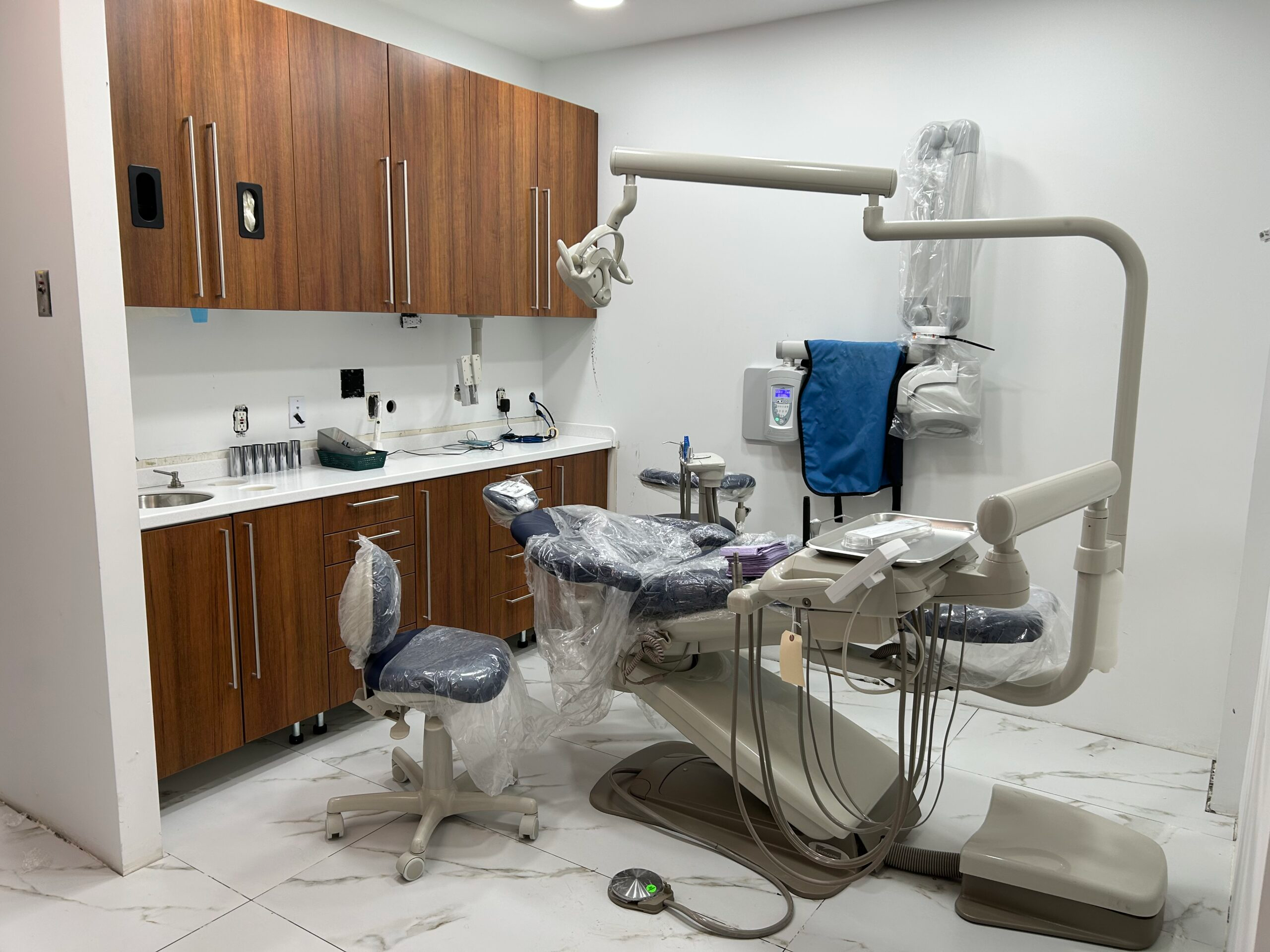
Before drywall goes up, we conduct a formal pre-install coordination meeting. This involves your equipment dealer, our project manager, and in many cases the manufacturer’s installation rep. We verify that every utility stub-out is in the correct location, every conduit is run, and every blocking element is in place — because once the walls are closed, accessing any of these without cutting is expensive.
This is also when we confirm delivery schedules for major equipment. Dental chairs, delivery systems, and cabinetry often have 8–16 week lead times. If your order isn’t placed by permit submission, equipment delivery can become your critical path item, pushing your opening date even if construction finishes on time. We flag this to every client during design. You can learn more about selecting the right dental chairs and their installation requirements — it directly affects rough-in sequencing.
wp:image {“id”:1224}
/wp:image
Phase 6: Drywall, Insulation, and Lead Lining
Typical Duration: 1–2 weeks
Drywall goes up once rough-in inspections are approved. In NYC, DOB requires a rough-in inspection by a city inspector before walls can be closed — scheduling that inspection and waiting for approval can add 3–7 days to this phase alone. In suburban markets, inspections are generally scheduled within 1–3 business days.
Sound insulation between operatories is installed during this phase — an often-overlooked detail that significantly affects patient experience. We use acoustic batts between operatory walls and where operatories share walls with waiting rooms or consultation rooms.
Phase 7: Finishes — Flooring, Painting, Ceilings, Tile
Typical Duration: 2–3 weeks
Finish work runs largely in sequence: ceiling grid and tile first (or drywall ceiling finishing), then painting, then hard flooring. Dental offices typically use luxury vinyl plank or tile in clinical areas for infection control compliance and easy maintenance. Operatory flooring must be seamless at the wall base or coved to prevent microbial accumulation — this is both an OSHA best practice and often a state health department requirement.
Phase 8: Equipment Installation and Casework
Typical Duration: 1–2 weeks
This is the phase our team at GCMM Dental Construction is specifically built for. Dental chair delivery units, cabinetry, sterilization equipment, and imaging systems are installed, connected to rough-in utilities, and tested. Because we’re manufacturer-trained on A-dec, Midmark, and Planmeca systems, we handle this directly — without subcontracting to a dealer tech who has never been on your jobsite before.
For CBCT and digital x-ray systems, the installation requirements are technical and specific. Lead lining must be verified, sensor placement confirmed with your radiation physicist, and all imaging equipment calibrated. Our guide on CBCT and x-ray system installation requirements covers the technical details that affect both your permit drawings and your final inspection.
Phase 9: Final Inspections and Certificate of Occupancy
Typical Duration: 1–3 weeks (jurisdiction dependent)
Final inspections for a dental office typically include a building inspection, electrical inspection, plumbing inspection, and in many jurisdictions, a separate fire protection or sprinkler inspection. In NYC, all of these are coordinated through DOB and can involve multiple inspection scheduling windows. The Certificate of Occupancy (or CO amendment for tenant fit-outs) is issued only after all sign-offs are recorded.
New Jersey requires a Certificate of Occupancy from the local Construction Official before any business can operate — municipalities vary in how quickly they schedule final inspections, but 1–2 weeks is typical once all work is complete and inspection requests are submitted. Westchester and Long Island municipalities follow similar processes.
Understanding who we are and how we manage this entire process as a full-service dental construction company helps explain why our clients reach their opening dates more predictably than with general contractors who don’t specialize in dental.
Total Timeline Summary by Region
- NYC (Manhattan, Brooklyn, Queens, Bronx, Staten Island): 7–12 months total (permitting is the dominant variable)
- Westchester County: 5–8 months total
- Long Island (Nassau/Suffolk): 5–7 months total
- New Jersey: 4–7 months total
- Connecticut: 4–7 months total
These ranges assume a straightforward tenant fit-out. Historic buildings, landmark districts, co-op or condo boards, and ground-up construction each add time and process layers.
Frequently Asked Questions
Why does NYC take so much longer than New Jersey for a dental office permit?
NYC DOB requires full plan examination for dental offices due to the medical use classification, plumbing complexity, and x-ray room requirements. The DOB examination queue, plus mandatory correction cycles, creates timelines that simply don’t exist in NJ or CT municipal departments where a single Construction Official reviews the plans directly.
Can construction phases overlap to save time?
Some phases can overlap with careful planning — for example, ordering equipment during permitting and beginning demolition the day permits are issued rather than waiting for a mobilization meeting. However, rough-in cannot begin until demolition is complete, and drywall cannot close until rough-in inspections pass. The sequence is largely fixed by inspection requirements.
When should I place equipment orders?
No later than permit submission — ideally earlier if you’ve confirmed your layout during design. Chair-delivery units, cabinetry, and CBCT systems routinely carry 10–16 week lead times. Missing this window is the single most common reason dental offices don’t open on their target date.
What does a dental office contractor do differently than a general contractor?
A specialized dental contractor brings manufacturer-trained equipment installation, familiarity with dental-specific code requirements (amalgam separators, lead-lined x-ray rooms, medical gas standards), and established relationships with equipment vendors — all of which reduce errors, change orders, and inspection failures. For the full picture, read about what your dental office contractor does each phase of the project.
Ready to Start Planning Your Dental Office Build?
Every week you spend in a space that isn’t yours is revenue that belongs to someone else. Our team at GCMM Dental Construction works with dentists across NYC, Westchester, Long Island, New Jersey, and Connecticut to build out practices that open on schedule, pass inspection the first time, and are equipped and installed by manufacturer-trained professionals.
Call us at (347) 961-7357, email gary@gcmm.nyc, or visit us at 876 Kinsella St, Bronx, NY to start your timeline conversation. We’ll tell you exactly what your permitting window looks like in your municipality and how to build a realistic construction schedule from day one.
With factory certification from A-dec, our team builds operatory rooms to exact equipment specifications. GCMM also offers commercial HVAC contractor for non-dental commercial projects. All work meets ADA dental office design guidelines.