
Book Appointment Now
Dental Office Construction in New Jersey: Full Guide
Dental office construction in Contractor New Jersey, NY. A-dec & Midmark certified contractor. Operatories, sterilization, equipment. Free assessment. Call (...
Dental Office Construction in New Jersey: Full Guide
Looking for dental office construction new jersey? New Jersey dentists planning a new build or renovation face a distinct set of regulatory, permitting, and logistical challenges that are genuinely different from what their counterparts across the river in New York City deal with. At GCMM Dental Construction, we’ve completed dental office projects throughout the tri-state area — from the Bronx to Bergen County — and that cross-market experience shapes how we approach every NJ project. This guide walks you through what you need to know about dental office construction in New Jersey, from facility regulations and permitting timelines to the types of projects we handle most often.
Professional Dental Office Construction New Jersey
If you’re a New Jersey dentist scouting a new location, planning a ground-up build, or finally pulling the trigger on a long-overdue renovation, this is the resource we wish every client had read before their first consultation call.
NJ Department of Health Regulations for Dental Office Facilities
In New Jersey, dental office construction and renovation is governed by a combination of the New Jersey Department of Health (NJDOH) standards, the New Jersey Uniform Construction Code (UCC), and local municipal codes. Unlike some states where dental offices are treated essentially like general medical offices, New Jersey applies specific facility standards to dental practices — particularly those providing sedation services or operating as group practices.
Our dental office construction new jersey team specializes in creating functional, code-compliant spaces tailored to your practice.
Here are the key regulatory areas your contractor must understand before breaking ground:
- Ventilation and air quality: NJ dental facilities must meet ASHRAE 170 ventilation standards for healthcare spaces, which specify minimum air changes per hour for operatory rooms, sterilization areas, and waiting rooms. This directly affects HVAC design and is non-negotiable at inspection.
- Plumbing and dental unit waterlines: New Jersey follows CDC dental waterline guidelines, and your build must accommodate separate potable water supply lines for each dental unit, along with proper drainage configurations for amalgam separators — which are required under EPA regulations enforced at the state level.
- Infection control zoning: NJDOH guidelines expect a clear functional separation between clean and contaminated zones within sterilization areas. This means your floor plan isn’t just about aesthetics — it has regulatory implications.
- Radiation shielding: X-ray rooms require lead shielding calculations submitted to and approved by the New Jersey Department of Environmental Protection (NJDEP), Bureau of X-Ray Compliance. This is a separate approval process from your building permit and must be completed before you can operate any radiographic equipment.
- ADA accessibility compliance: All new construction and significant renovations must meet ADA standards. Our team builds ADA-compliant construction into every project from the design phase — not as an afterthought.
One thing we often see with dentists who try to manage permitting themselves: the NJDEP radiation shielding approval gets overlooked until late in the project, causing costly delays. We manage this process as part of our standard project workflow on every New Jersey dental office build.
wp:image {“id”:1261}
/wp:image
How NJ Permitting Compares to NYC
This is one of the most practical questions we get from dentists who are relocating from New York or opening a second location in New Jersey. The honest answer: NJ permitting is generally faster and less layered than NYC, but it comes with its own set of requirements that catch out-of-state contractors off guard.
NYC Permitting: Highly Centralized, Notoriously Complex
In New York City, all construction permitting flows through the NYC Department of Buildings (DOB), with additional sign-offs from agencies like the NYC Department of Health and Mental Hygiene for certain dental applications. Plans must be filed by a licensed New York Registered Architect or Professional Engineer, and projects in older buildings often trigger additional reviews — landmarks, asbestos surveys, and HPD compliance for mixed-use buildings. DOB inspections are scheduled through a centralized system, and getting an inspection appointment on your timeline isn’t always guaranteed.
NJ Permitting: Municipal-Level, More Predictable
In New Jersey, construction permitting is handled at the municipal level by your local construction official under the NJ UCC. This means permitting timelines and processes can vary meaningfully between, say, Jersey City and Paramus. However, what you typically gain is a more direct relationship with local inspectors and shorter wait times for reviews and inspections.
Key differences our team navigates regularly:
- NJ requires a Certificate of Occupancy (CO) or Certificate of Approval from the local construction official before you can operate — this is the final milestone that unlocks your practice opening date.
- Dental-specific mechanical, electrical, and plumbing (MEP) permits are pulled separately from the construction permit in most NJ municipalities, which means parallel processing is possible and we take full advantage of that to compress timelines.
- Fire subcode inspections in NJ are conducted by the local Fire Prevention Bureau — in some Bergen County and Essex County municipalities, we’ve found these inspectors particularly thorough on dental-specific requirements like medical gas storage.
- NJDEP approval for X-ray rooms is a state-level process that runs parallel to but independent of local permitting — and it’s one that many general contractors simply don’t know how to handle.
Because we operate as dental office construction specialists throughout New Jersey, we’ve built relationships with construction officials in multiple NJ counties and know how to structure project sequencing to avoid the delays that trip up contractors who only occasionally work in this market.
wp:image {“id”:1224}
/wp:image
Common Project Types We Handle in New Jersey
Our New Jersey dental construction work spans a wide range of project types and practice sizes. Here’s a realistic look at the projects we handle most frequently:
Ground-Up New Builds
These are typically standalone dental buildings or dental suites within a newly constructed professional office building. New builds in NJ suburban markets — think Middlesex County, Morris County, or Monmouth County — often involve working directly with commercial developers. We coordinate with the developer’s architect to ensure dental-specific MEP requirements (medical gas rough-ins, dental unit waterlines, amalgam separator drains) are incorporated during the core-and-shell phase rather than retrofitted later, which saves real money.
Tenant Improvements in Existing Commercial Space
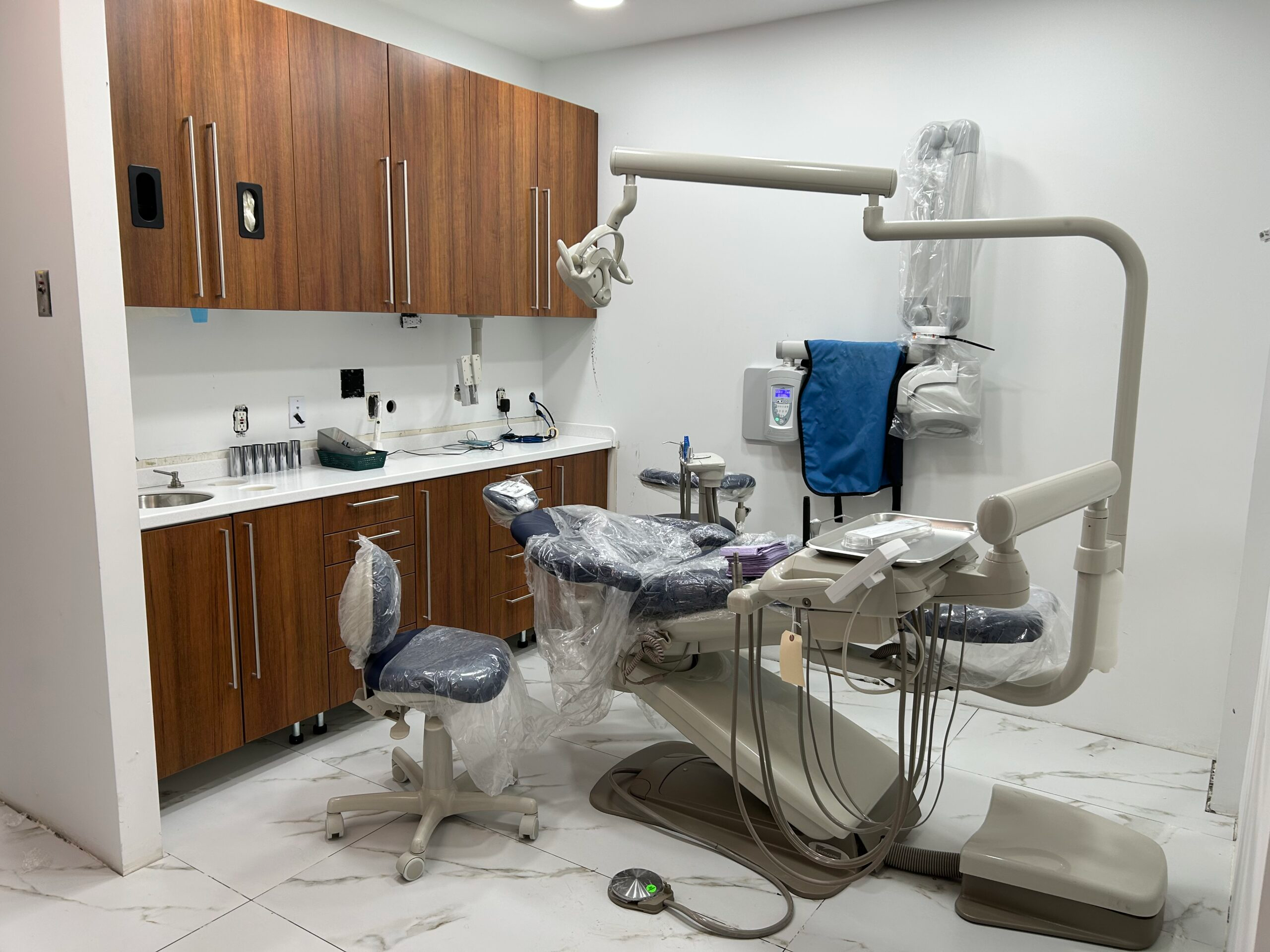
This is the most common project type. A dentist signs a lease in a strip mall, medical office park, or mixed-use building and needs the raw space built out as a fully functional dental office. A typical NJ dental office tenant improvement for a solo practitioner might involve 4–6 operatories, a sterilization room, a digital X-ray suite, a private consultation room, a reception area, and staff break room — all within 1,800 to 2,800 square feet. We’ve completed projects like this in locations ranging from Hackensack to Cherry Hill.
Dental Office Renovations
Many established NJ dental practices are working out of offices built in the 1990s or early 2000s — layouts designed before cone beam CT scanners, intraoral cameras, and modern digital workflows were standard. A renovation might involve opening up the operatory layout, upgrading the sterilization center to meet current infection control standards, or completely replumbing for new dental units. Our team specializes in dental clinic renovation work that keeps disruption to an active practice as minimal as possible — phased renovations, after-hours scheduling, temporary operatory configurations.
Equipment Replacement and Integration
We’re manufacturer-trained by A-dec, Midmark, and Planmeca — three of the most widely specified dental equipment brands in NJ practices. Equipment replacement projects that involve new chair-delivery unit systems require coordinated plumbing, electrical, and cabinetry work that a general contractor simply isn’t equipped to handle correctly. We’ve seen practices lose weeks to rework because a non-specialized contractor connected a new A-dec unit incorrectly. That doesn’t happen on our projects. If you’re weighing your equipment options, our contractor’s guide to dental chair selection and installation walks through the practical considerations in detail.
wp:image {“id”:1260}
/wp:image
Why Cross-Market Experience in NYC and NJ Matters
There’s a real and underappreciated advantage to working with a contractor who has deep experience in both the NYC and New Jersey markets. Here’s what that actually means in practice:
We understand dental office design at a level most NJ contractors don’t. The majority of commercial contractors in New Jersey have built restaurants, retail spaces, and general medical offices. Dental construction is a specialty. The ergonomic positioning of dental units, the zoning requirements for sterilization, the specific rough-in tolerances for chair-mounted delivery systems — these are learned through repetition, not a weekend course. Our team has completed dental projects across NYC’s five boroughs, Westchester, Long Island, and throughout New Jersey, which means that institutional knowledge is deep.
We move between regulatory environments fluently. A contractor who only works in NJ might stumble when a project crosses into Jersey City and faces quasi-NYC inspection standards, or when a project requires coordination between NJ UCC and federal ADA enforcement. We deal with regulatory complexity as a baseline condition of our work.
We have supply chain relationships that benefit NJ clients. Our proximity to NYC’s dental supply and equipment dealer network means faster equipment delivery, better coordination on lead times, and direct relationships with Planmeca, Midmark, and A-dec representatives who support our NJ installs.
Before you commit to any contractor for a New Jersey dental build, we’d encourage you to read our breakdown of the most costly mistakes dentists make when building a new office — many of them stem directly from choosing a contractor without dental-specific experience.
What to Expect Working With GCMM in New Jersey
We handle New Jersey dental construction projects from initial consultation through certificate of occupancy — and through equipment installation and commissioning. Our process includes:
- Pre-construction regulatory review (NJ UCC, NJDEP X-ray approval, local municipality requirements)
- Coordination with your equipment vendors and dental supply reps during design
- MEP coordination with licensed NJ subcontractors
- Phased scheduling to minimize downtime for renovation projects
- Manufacturer-trained installation of A-dec, Midmark, and Planmeca systems
- Final walkthrough and punch list against both code requirements and your operational specifications
Frequently Asked Questions
How long does a dental office buildout take in New Jersey?
A tenant improvement buildout in an existing NJ commercial space typically runs 12–20 weeks from permit approval to certificate of occupancy, depending on project complexity and municipality. Ground-up builds run longer. We provide project-specific timelines during our initial consultation.
Do I need a separate architect for my NJ dental office project?
Yes. NJ UCC requires construction documents to be prepared and signed by a licensed New Jersey Registered Architect or Professional Engineer for most commercial projects. We work with trusted dental architecture partners in the NJ market and can make introductions as part of our project coordination.
What does dental office construction cost per square foot in New Jersey?
NJ dental office construction typically runs between $180–$350+ per square foot for tenant improvements, depending on the scope of MEP work, cabinetry specification, and equipment integration. New builds and full gut renovations trend higher. For a more detailed breakdown of construction costs across our service area, see our 2026 dental contractor cost guide.
Can GCMM handle both the construction and equipment installation?
Yes — and this is one of our core differentiators. We are manufacturer-trained by A-dec, Midmark, and Planmeca, which means we handle dental unit installation, plumbing connections, and electrical hookups as part of our construction scope. You’re not coordinating two separate vendors.
Ready to Start Your New Jersey Dental Office Project?
Whether you’re breaking ground on a new practice or modernizing an existing one, working with dental office contractors working in New Jersey who understand both the regulatory environment and the technical demands of dental construction makes a measurable difference in your project outcome. We’re that team.
Contact GCMM Dental Construction to schedule a consultation for your New Jersey dental office project:
- Phone: (347) 961-7357
- Email: gary@gcmm.nyc
- Office: 876 Kinsella St, Bronx, NY
We serve dentists throughout New Jersey — from Bergen and Hudson counties to Middlesex, Monmouth, Essex, and beyond. Call (347) 961-7357 today and let’s talk through your project.
GCMM Dental Construction is factory-trained by A-dec builds operatory rooms to exact equipment specifications. For general commercial construction, visit GCMM Home Improvement for commercial HVAC contractor. All designs comply with ADA dental office design guidelines.