
Book Appointment Now
Comparing Dental Construction Companies: What Matters Most
Comparing Dental Construction Companies: What Matters Most. Expert insights from GCMM Dental Construction. Call (347) 961-7357 for your project.
Comparing Dental Construction Companies: What Matters Most
Looking for dental construction companies comparison? When you’re preparing to build or renovate a dental office in New York, New Jersey, or Connecticut, one of the most consequential decisions you’ll make is choosing the right contractor. The question we hear most often from dentists isn’t just “who’s available?” — it’s “what’s actually the difference between a dental construction specialist and a general commercial contractor?” The answer is significant, and getting it wrong costs practices real money, real time, and real headaches during their busiest launch windows.
Professional Dental Construction Companies Comparison
This comparison framework breaks down the critical evaluation criteria you should apply when reviewing any construction company for your dental buildout. We’ve structured it around the factors that actually determine project success — not just price and timeline, but technical capability, regulatory knowledge, and the kind of post-installation support that keeps your equipment running on day one.
If you’re still early in your research, our in-depth guide on 5 Costly Mistakes Dentists Make When Building a New Office is required reading before you sign any contract.
Our dental construction companies comparison team specializes in creating functional, code-compliant spaces tailored to your practice.
The Core Question: Dental Specialist vs. General Commercial Contractor
A general commercial contractor is trained to build out retail spaces, offices, restaurants, and medical suites. They understand framing, drywall, flooring, HVAC, and basic electrical and plumbing. For most commercial projects, that’s sufficient. But a dental office isn’t a general commercial project — it’s a highly technical healthcare environment where the construction and the equipment are inseparable systems.
Here’s how the two approaches stack up across the criteria that matter most for dental buildouts:
1. Dental Equipment Installation Capabilities
General Commercial Contractor: Can install walls, cabinetry, and rough-in utilities to a specification sheet. Will typically subcontract or defer to equipment vendors for the actual dental unit installation. This handoff creates coordination gaps — the contractor finishes their scope, the equipment vendor arrives, and suddenly there are conflicts between rough-in locations and actual unit requirements.
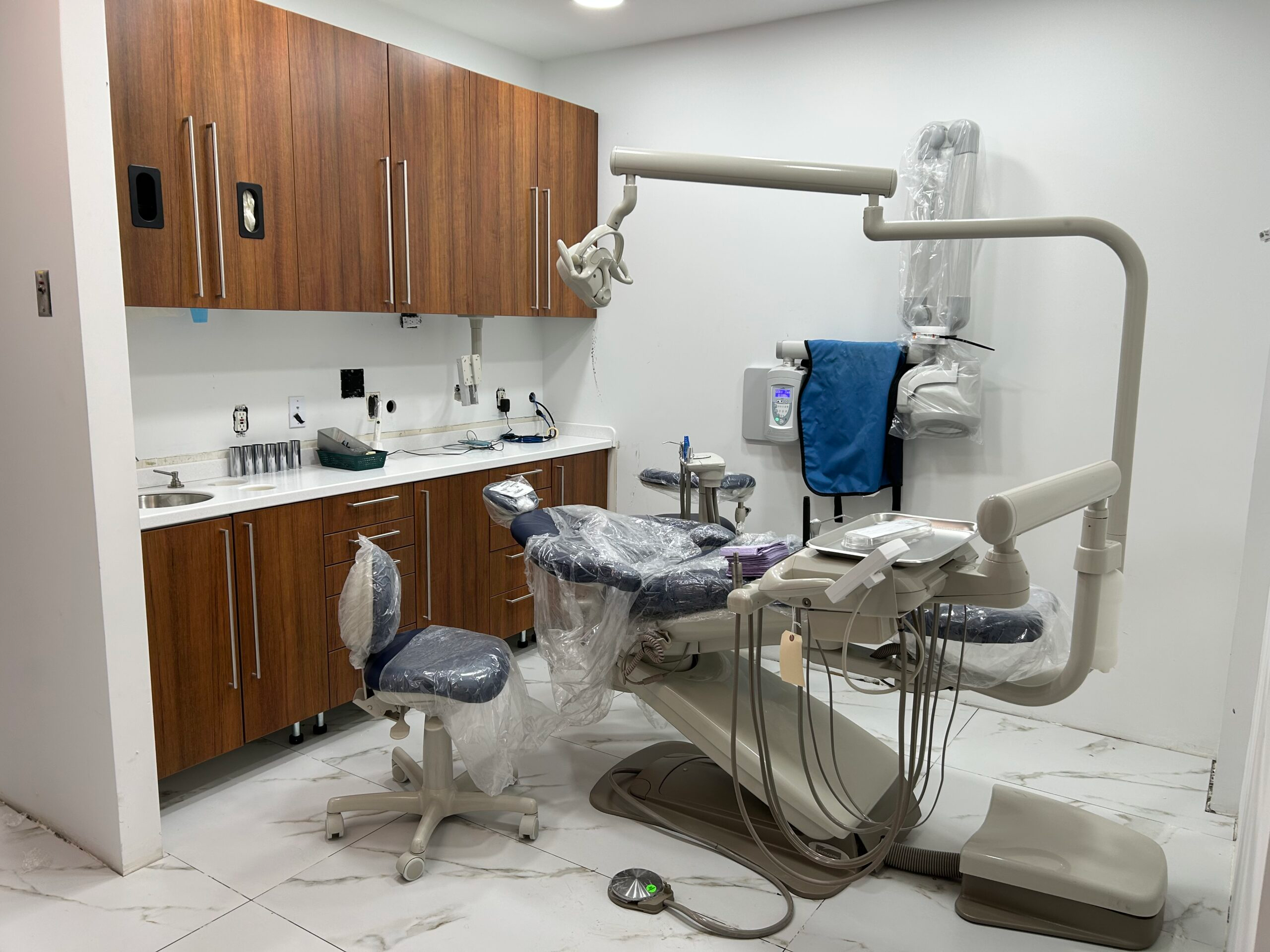
Dental Construction Specialist: Integrates equipment installation into the construction process from the start. At GCMM Dental Construction, our team is manufacturer-trained by A-dec, Midmark, and Planmeca — meaning we don’t just read a spec sheet, we’ve completed the hands-on certification programs those manufacturers use to qualify their own installers. We know the precise utility requirements for each unit model before a single wall goes up.
This matters enormously during rough-in. Dental chairs, delivery systems, and imaging equipment require specific locations for compressed air lines, vacuum lines, electrical circuits, and data conduit. A general contractor working from a floor plan alone will rough-in to approximate locations. A manufacturer-trained team rough-ins to exact tolerances, eliminating the costly re-work that happens when equipment doesn’t align with utility stub-outs.
wp:image {“id”:1261}
/wp:image
2. Dental-Specific Plumbing and Electrical Experience
General Commercial Contractor: Licensed for standard commercial plumbing and electrical work. Capable of meeting code for typical tenant improvements. However, dental-specific systems — amalgam separators, nitrous oxide delivery lines, central vacuum, air compressor rooms, and digital X-ray electrical shielding — often fall outside their experience base. Mistakes here aren’t just inconvenient; they can result in failed inspections, equipment warranty voidance, or environmental compliance violations.
Dental Construction Specialist: Has completed dozens of dental-specific utility installations and understands the nuanced requirements involved. For example, dental vacuum systems require larger-diameter drain lines with specific slope grades to prevent clogging — a detail that’s irrelevant in a standard office buildout but critical in a dental environment. Similarly, digital radiography rooms in New York City require lead-lined shielding installed to NCRP 147 guidelines, which must be verified by a radiation safety consultant. Our team coordinates this process routinely on projects across the Bronx, Manhattan, Long Island, and Westchester.
Nitrous oxide and oxygen systems require dedicated medical gas piping — a specialized discipline that general contractors rarely touch. In New Jersey and Connecticut projects, we’ve encountered general contractors who planned to use standard copper gas lines for nitrous delivery, which is both a code violation and a safety hazard. Proper DISS fittings, zone valves, and pressure alarm systems aren’t optional — they’re required.
3. Manufacturer Certifications and Training
This is a differentiator that most dentists don’t think to ask about — until something goes wrong during installation.
General Commercial Contractor: Has no relationship with dental equipment manufacturers and typically no certification in dental equipment installation. They rely entirely on the equipment vendor’s field technician, which creates a two-party installation process with divided accountability.
Dental Construction Specialist: Manufacturer training programs like those offered by A-dec, Midmark, and Planmeca exist specifically to qualify contractors who will be responsible for the physical installation environment. Being A-dec trained means our team understands that an A-dec 500 delivery system requires specific cabinetry depths, specific utility access panels, and specific floor-mount tolerance ranges. Being Midmark trained means we know how their integrated cabinetry systems interface with their 413 chair series before we design the operatory layout.
Our contractor’s guide to dental chair selection and installation walks through exactly how these equipment decisions affect construction planning — and why the chair you select should be confirmed before your operatory walls are framed, not after.
wp:image {“id”:1260}
/wp:image
4. Local Permit Track Records
General Commercial Contractor: May have strong permit relationships with their local municipality but limited experience navigating the specific requirements of dental healthcare construction permits. In New York City, dental office construction requires Department of Buildings filings, DOH-related healthcare facility compliance reviews, and in many cases, fire suppression and egress analysis that general commercial work doesn’t trigger. Contractors unfamiliar with these pathways often cause permit delays of four to eight weeks on dental projects.
Dental Construction Specialist: Has an established track record with the specific permit categories relevant to dental construction. For NYC projects, we work with architects and expediters who know the DOB’s healthcare occupancy review process. For Long Island projects under Nassau or Suffolk County jurisdiction, we understand the local Health Department requirements for dental waste disposal systems. For New Jersey projects, we navigate the specific DCA permitting requirements that apply to medical office construction.
Permit delays are one of the most common causes of missed lease commencement dates in dental buildouts. When you’re paying rent on a space before you can see a single patient, every week of delay is direct financial loss. Our permit management process includes pre-submission coordination with plan examiners, which routinely reduces review cycles compared to first-time filers.
5. Project Management Approach for Dental Timelines
Dental office construction has a timeline structure that’s different from typical commercial work. Most dentists have a hard open date tied to a lease commencement, a practice transition, or a patient communication campaign. Missing that date doesn’t mean an inconvenience — it means a practice that isn’t generating revenue yet is still paying for everything.
General Commercial Contractor: Manages timelines using standard commercial construction sequencing. Equipment installation is typically treated as an owner-furnished item that gets coordinated after construction is “substantially complete.” This approach almost always pushes equipment commissioning — the process of testing, calibrating, and activating dental units — into the final week before opening, leaving no buffer for equipment or utility issues.
Dental Construction Specialist: Sequences construction around equipment installation milestones. At GCMM Dental Construction, our project management process includes equipment delivery coordination, manufacturer representative scheduling, and a dedicated commissioning phase that happens before punch-list — not during it. We’ve managed buildouts in Westchester where the tenant’s lease had a 90-day construction window with a personal guarantee tied to the open date. That kind of pressure requires a project management approach built for dental timelines, not adapted from commercial retail.
wp:image {“id”:1224}
/wp:image
Side-by-Side Comparison Summary
- Equipment Installation: General contractor defers to vendors; dental specialist integrates equipment into construction scope from day one.
- Dental Plumbing: General contractor handles standard commercial systems; dental specialist manages vacuum lines, amalgam separators, medical gas, and dental-specific drain requirements.
- Dental Electrical: General contractor meets standard code; dental specialist handles X-ray shielding, dedicated circuits for compressor rooms, and equipment-specific panel requirements.
- Manufacturer Certifications: General contractor has none; dental specialist holds certifications with A-dec, Midmark, Planmeca, and other major manufacturers.
- Permit Knowledge: General contractor knows standard commercial permits; dental specialist navigates DOB healthcare filings, DOH requirements, and county health department reviews.
- Timeline Management: General contractor uses standard commercial sequencing; dental specialist uses dental-milestone-driven scheduling with commissioning built in before punch-list.
- ADA Compliance: General contractor meets basic accessibility code; dental specialist designs operatory layouts, reception areas, and patient flow paths to ADA standards specific to healthcare environments.
What to Ask Any Contractor Before You Hire
When you’re comparing dental construction companies, use these specific questions to separate genuine specialists from contractors who’ve done one or two dental projects and are marketing themselves as experts:
- Which dental equipment manufacturers have certified your team, and can you provide documentation?
- How many dental operatories have you personally rough-in and installed in the last 24 months?
- Who handles permit filing for dental-specific requirements — your team or an expediter, and what’s your average permit review timeline in this jurisdiction?
- How do you coordinate between construction completion and equipment commissioning?
- Have you installed CBCT or cone beam imaging systems, and what shielding documentation did you provide to the building department?
- What’s your process if a utility rough-in conflicts with equipment installation requirements?
For practices planning to include advanced imaging, our detailed guide on CBCT and X-ray system installation requirements explains exactly what a qualified contractor needs to know before your imaging room is framed — including shielding calculations, room dimensions, and electrical isolation requirements that are frequently underestimated by general contractors.
Frequently Asked Questions
Is it always worth hiring a dental-specific construction company over a general contractor?
For new builds and full renovations involving dental equipment installation, yes — consistently. The cost difference between a specialist and a general contractor is typically offset within the first few weeks of construction by avoided re-work, faster permit processing, and smoother equipment commissioning. For minor cosmetic renovations that don’t touch utilities or equipment, a qualified general contractor may be sufficient, but you should still verify they understand dental code requirements in your specific jurisdiction.
What’s the typical difference in project timeline between a dental specialist and a general contractor?
In our experience, dental specialists complete buildouts in comparable or shorter timeframes because the coordination gaps between construction and equipment installation are eliminated. The real difference is in how much of that timeline is consumed by re-work — with a general contractor on a dental project, re-work and equipment coordination delays account for 20–30% of timeline overruns we’ve been brought in to rescue.
Do manufacturer certifications affect my equipment warranty?
Yes, in some cases. Several major dental equipment manufacturers, including Midmark, include installation quality in their warranty terms. If a non-certified installer completes the rough-in and the unit experiences a utility-related failure in the first year, the manufacturer’s warranty response may be complicated by questions about installation compliance. Working with a manufacturer-certified installer eliminates this ambiguity entirely.
Working With GCMM Dental Construction
We’ve completed dental office buildouts across New York City, Westchester, Long Island, New Jersey, and Connecticut — from single-operatory startups in the Bronx to multi-operatory specialty practices on Long Island. Our team brings manufacturer-trained equipment installation, dental-specific MEP coordination, and a project management process built around dental open dates, not general commercial sequencing.
If you’re in the process of evaluating contractors for your dental office project, we’re happy to walk through your space plan, your equipment list, and your timeline to give you a realistic picture of what’s involved — and what questions you should be asking every contractor you speak with.
The decision framework for choosing between dental office contractors and construction companies ultimately comes down to technical accountability. Who owns the outcome when a utility doesn’t align with equipment? Who’s responsible when an inspection fails over a dental-specific requirement? A specialist answers both questions clearly. A general contractor often can’t.
Contact our team directly to discuss your project: call us at (347) 961-7357, email gary@gcmm.nyc, or visit our office at 876 Kinsella St, Bronx, NY. We serve practices throughout NYC, Westchester, Long Island, New Jersey, and Connecticut, and we’re ready to talk through your buildout in specific, practical terms — no generic proposals, no vague timelines.
As a manufacturer-trained contractor with certification from A-dec, GCMM builds operatory rooms to exact equipment specifications. For broader commercial construction needs, our parent company GCMM Home Improvement provides commercial HVAC contractor. All projects follow ADA dental office design guidelines.