
Book Appointment Now
ADA Compliant Dental Office Construction Requirements
ADA Compliant Dental Office Construction Requirements. Expert insights from GCMM Dental Construction. Call (347) 961-7357 for your project.
ADA Compliant Dental Office Construction Requirements
Building a dental office that meets Americans with Disabilities Act (ADA) standards isn’t just a legal obligation — it’s a fundamental part of designing a practice that serves every patient with dignity and efficiency. At GCMM Dental Construction, we work with dentists across NYC, Westchester, Long Island, New Jersey, and Connecticut who are either building new practices from the ground up or renovating existing spaces that were never designed with accessibility in mind. In both scenarios, understanding the specific ADA requirements that apply to dental environments is critical to avoiding costly retrofits, permit delays, and potential civil liability down the road.
This guide breaks down the exact ADA requirements relevant to dental office construction — from operatory turning radius and equipment positioning to restroom grab bars, reception desk heights, parking compliance, and signage standards. We also explain how our team integrates compliance from the earliest design phase so that accessibility is built in, not bolted on.
Why ADA Compliance Is Different for Dental Offices
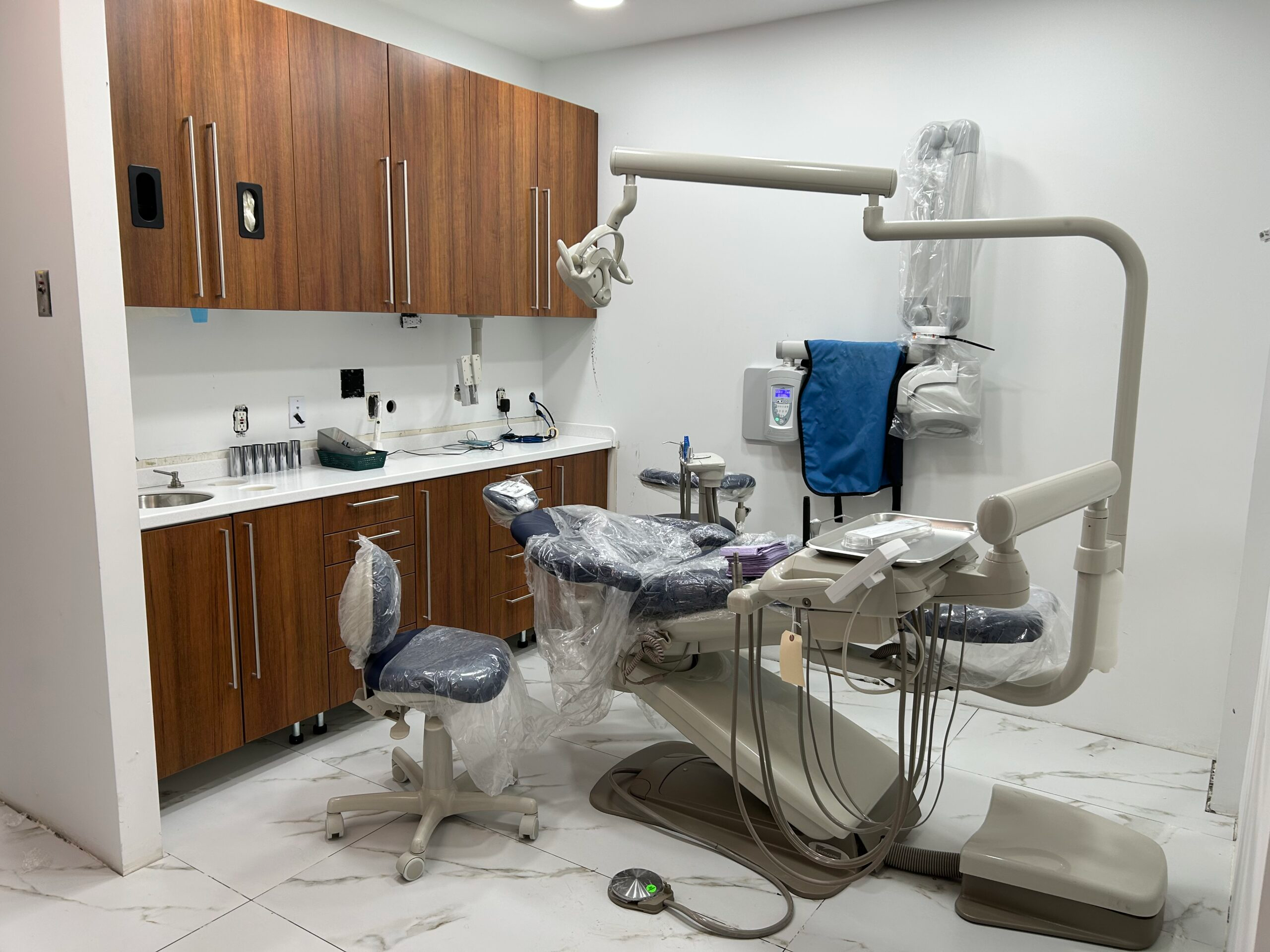
General commercial construction has baseline ADA requirements, but dental offices introduce unique challenges that standard contractors often overlook. You’re dealing with specialized fixed equipment — dental chairs, delivery units, overhead lights, cabinetry systems — in spaces that are often compact by design. When you add ADA turning clearances and reach range requirements into a 10×12 operatory, the layout math gets complicated fast.
Our ADA Dental Compliance Construction services are specifically structured around these challenges. We don’t apply a generic commercial ADA checklist to a dental floor plan. We apply dental-specific spatial planning that accounts for how treatment actually happens in an accessible environment.
Non-compliance carries real consequences. In New York and throughout the tri-state area, Certificate of Occupancy inspections include ADA review. We’ve seen practices in the Bronx, Long Island, and New Jersey face expensive corrections after construction was complete — corrections that would have cost a fraction of the price if addressed during design.
wp:image {“id”:1261}
/wp:image
Operatory Design: Turning Radius and Floor Clearance Requirements
The operatory is where ADA compliance gets technically demanding. Under ADA Standards for Accessible Design (Section 809 and the relevant healthcare facility guidelines), a wheelchair user must be able to approach, transfer to, and maneuver within the treatment space. Here’s what that means in practice:
Turning Radius
A minimum 60-inch diameter (5-foot) clear floor space is required for wheelchair turning. In a typical 10×12 operatory, that turning circle must be accounted for in the floor plan before any cabinetry, chair bases, or delivery unit positions are finalized. We position the dental chair base, doctor’s cart, and assistant’s cabinetry after mapping the required clearance zones — not before.
Parallel and Forward Approach Clearance
ADA requires either a 30×48-inch parallel approach or a 36×48-inch forward approach clear floor space at fixed equipment. For dental chairs specifically, the transfer side of the chair must have unobstructed floor clearance so a wheelchair user can transfer laterally. This affects where your delivery unit mounts and where assistant cabinetry sits along the wall.
Equipment Positioning for Accessible Treatment
We’re manufacturer-trained installers for A-dec, Midmark, and Planmeca — three of the most widely specified dental equipment brands in accessible practice design. Midmark’s dental chair line, in particular, includes ADA-compliant chair heights (as low as 15 inches from floor to seat) and flat positioning capabilities that make patient transfer significantly easier. We coordinate equipment positioning during the rough-in phase so that plumbing, electrical, and gas stub-outs align with the accessible configuration — not a standard configuration retrofitted later.
Reception Desk and Check-In Counter Heights
ADA Section 904 (Sales and Service Counters) requires that at least one portion of any service counter be accessible. For dental reception desks, this means:
- Maximum counter height of 36 inches for the accessible portion
- Minimum 36-inch clear width at the accessible section
- Knee clearance of 27 inches high, 25 inches deep, and 30 inches wide if a forward approach is provided
- The accessible section must be on an accessible route — meaning a wheelchair user can reach it without passing through a non-accessible path
In practices we’ve built across Westchester and Long Island, we often design a split-level reception desk — a standard-height section for standing staff interaction and a 36-inch accessible section that integrates seamlessly into the millwork design. This isn’t a visual compromise. Done correctly, it’s a design feature. We work with dental-specific millwork fabricators who understand how to build accessible casework that looks intentional, not like a compliance afterthought.
wp:image {“id”:1260}
/wp:image
Restroom ADA Requirements for Dental Offices
Dental office restrooms require full compliance with ADA Section 603 (Toilet and Bathing Rooms). The specific requirements most commonly missed in dental build-outs include:
Grab Bar Placement
- Rear wall grab bar: Minimum 36 inches long, centered at 33–36 inches above the finished floor
- Side wall grab bar: Minimum 42 inches long, beginning no more than 12 inches from the rear wall, at 33–36 inches above finished floor
- Grab bars must support a 250-pound load — this means blocking must be installed in the wall framing during rough carpentry, before drywall goes up. We install backing as standard practice on every dental office restroom we build.
Toilet Positioning and Clear Floor Space
The toilet centerline must be positioned 16–18 inches from the side wall. A 60-inch minimum clear floor space measured from the side wall is required for wheelchair approach. Toilet seat height must be 17–19 inches from finished floor — standard residential toilet heights often fall below this range, which is why we specify commercial-grade ADA-compliant fixtures on every project.
Door Width and Maneuvering Clearance
Restroom doors must provide a minimum 32-inch clear opening width (measured from the door face to the stop), and maneuvering clearance on the pull side must be at least 18 inches beyond the latch edge. In tight dental office layouts — a common reality in Manhattan and urban Bronx spaces — this clearance is often where conflicts arise. We identify these conflicts during design development, not during framing.
wp:image {“id”:1224}
/wp:image
Parking and Site Accessibility
For practices with dedicated parking — more common in suburban Connecticut, New Jersey, and Long Island locations than in urban NYC — ADA parking requirements under Section 502 include:
- Van-accessible spaces must be provided at a ratio of 1 per 6 accessible spaces
- Standard accessible spaces: minimum 8 feet wide with a 5-foot access aisle
- Van-accessible spaces: minimum 8 feet wide with an 8-foot access aisle (or 11 feet wide with a 5-foot aisle)
- Accessible spaces must be on the shortest accessible route to the building entrance
- Signage must include the International Symbol of Accessibility mounted at 60–66 inches above grade
In many cases we work with the building’s civil engineer or the property management company to ensure parking compliance is coordinated before we begin interior work. If parking is non-compliant, the interior work alone won’t satisfy the overall accessibility requirements for the Certificate of Occupancy.
ADA Signage Standards for Dental Offices
Signage compliance is frequently under-specified in dental office construction drawings. ADA Section 703 requires:
- Raised characters and Braille on all permanent room identification signs (operatories, restrooms, consultation rooms, staff areas)
- Characters must be between 5/8 inch and 2 inches in height, with a sans-serif font
- Sign mounting height: 60 inches to centerline above finished floor
- Signs must be mounted on the latch side of the door, on the wall adjacent to the door
- Non-glare finish with 70% contrast between characters and background
We coordinate with ADA-compliant signage vendors as part of our finish specification package. This is included in our project scope — signage is not an afterthought purchased by the doctor separately and installed incorrectly.
How GCMM Integrates ADA Compliance from Day One
The most expensive ADA problems in dental construction happen when compliance is treated as a final checklist item rather than a design driver. Our process integrates ADA review at three specific phases:
Phase 1: Schematic Design
Before a single wall location is committed to paper, we review the floor plan against ADA turning clearances, accessible route requirements, and operatory approach zones. We’ve redesigned corridor widths, shifted restroom locations, and repositioned reception desk orientations at this stage — changes that cost nothing when made on paper and tens of thousands when made during construction.
Phase 2: Construction Documents
Our construction drawings include specific ADA notations — grab bar backing locations, accessible hardware specifications, door clearance dimensions, and counter height callouts. This documentation supports permit submissions in NYC, Westchester, Nassau County, and other jurisdictions where plan examiners look specifically at accessibility compliance.
Phase 3: Equipment Installation
Because we’re manufacturer-trained on A-dec, Midmark, and Planmeca systems, our equipment installation confirms ADA-compliant positioning during rough-in — not after the fact. For more detail on how equipment installation intersects with construction, see our contractor’s guide to dental chair selection and installation, which covers transfer clearance, chair height specifications, and delivery unit positioning in accessible operatory layouts.
Frequently Asked Questions
Does every dental office need to be fully ADA compliant?
Yes. Dental offices are places of public accommodation under Title III of the ADA, which means they must be accessible to patients with disabilities regardless of building age. New construction must meet full ADA Standards. Existing facilities undergoing alterations must bring altered elements into compliance, and barriers must be removed when “readily achievable.”
What’s the most commonly missed ADA requirement in dental offices?
In our experience across NYC and the tri-state area, the most commonly missed items are restroom grab bar backing (installed after drywall, which requires demolition), operatory clear floor space (operatories designed at minimum size with no turning clearance), and reception desk height (no accessible section provided at all).
Can an existing dental office be grandfathered from ADA requirements?
Not when alterations are made. Once you begin construction — even a partial renovation — the areas being altered must be brought into compliance. This is why ADA planning matters even in renovation projects, not just ground-up construction.
Does GCMM handle ADA compliance documentation for permit submissions?
Yes. Our construction documents include ADA compliance notations, and our team coordinates with the design architect to ensure permit submissions in NYC, Westchester, Long Island, New Jersey, and Connecticut reflect current ADA Standards for Accessible Design.
Work With ADA-Experienced Dental Office Contractors
ADA compliant dental office construction requires a contractor who understands both the regulatory framework and the specific realities of dental practice design. Generic commercial contractors don’t know the difference between a Midmark 413 and an A-dec 511 — and they don’t know how dental chair transfer clearances affect your entire operatory layout.
If you’re planning a new dental office or renovating an existing space in NYC, Westchester, Long Island, New Jersey, or Connecticut, we’d encourage you to work with dental office contractors who build ADA compliant practices from the design phase forward — not contractors who check ADA boxes at the end of a project.
You can also learn more about our team and our approach to dental-specific construction on our About Us page.
Ready to discuss your dental office project? Call us at (347) 961-7357 or email gary@gcmm.nyc. Our team at 876 Kinsella St, Bronx, NY serves practices across the entire tri-state region and is ready to walk you through what ADA compliance means for your specific space, lease conditions, and equipment selections.
GCMM Dental Construction is factory-trained by A-dec builds operatory rooms to exact equipment specifications. For general commercial construction, visit GCMM Home Improvement for commercial HVAC contractor. All designs comply with ADA dental office design guidelines.