
Book Appointment Now
dental practice design build contractors
dental practice design build contractors. Expert insights from GCMM Dental Construction. Call (347) 961-7357 for your project.
“`html Meta Description: Why Westchester, NYC & Long Island dentists choose GCMM for dental practice design build contractors — ADA-compliant, manufacturer-trained, full-service. Call (347) 961-7357.
Why Westchester, NYC & Long Island Residents Choose GCMM Dental Construction for Dental Practice Design Build Contractors
When dental practice owners in Westchester, NY, New York City, and Long Island compare their options for dental practice design build contractors, they quickly discover a meaningful gap between regional specialists and generic commercial contractors. A general contractor in White Plains might build tenant improvements for retail and restaurant spaces; a dental-specific design build firm understands that a four-operatory practice in Scarsdale requires a completely different mechanical infrastructure than a suburban sandwich shop three doors down. We built GCMM Dental Construction specifically to close that gap — delivering fully integrated design, permitting, construction, and equipment installation under one roof, across all three of the New York metro’s most demanding dental markets.
Compare, for example, a dental startup in Midtown Manhattan versus a similar buildout in Garden City, Long Island. In Midtown, you’re navigating a Class A high-rise with strict tenant coordination requirements, elevator scheduling for equipment deliveries, and New York City’s Department of Buildings (DOB) plan examination process, which averaged 8–14 weeks for healthcare-occupancy filings as of early 2026. In Garden City, you’re dealing with Nassau County Health Department sign-off, Nassau County Department of Building inspections, and a suburban strip-mall landlord who may have never hosted a dental tenant. Then consider a Westchester practice in Yonkers or New Rochelle: Westchester County requires separate plumbing and electrical inspections, and many municipalities — including Mount Vernon, Tarrytown, and White Plains — have adopted the 2022 New York State Building Code amendments, which have specific accessibility requirements that directly affect dental operatory layouts. Each of these markets demands local knowledge, not a one-size-fits-all construction template.
Architectural Realities Across Westchester, NYC & Long Island — And What They Mean for Your Practice
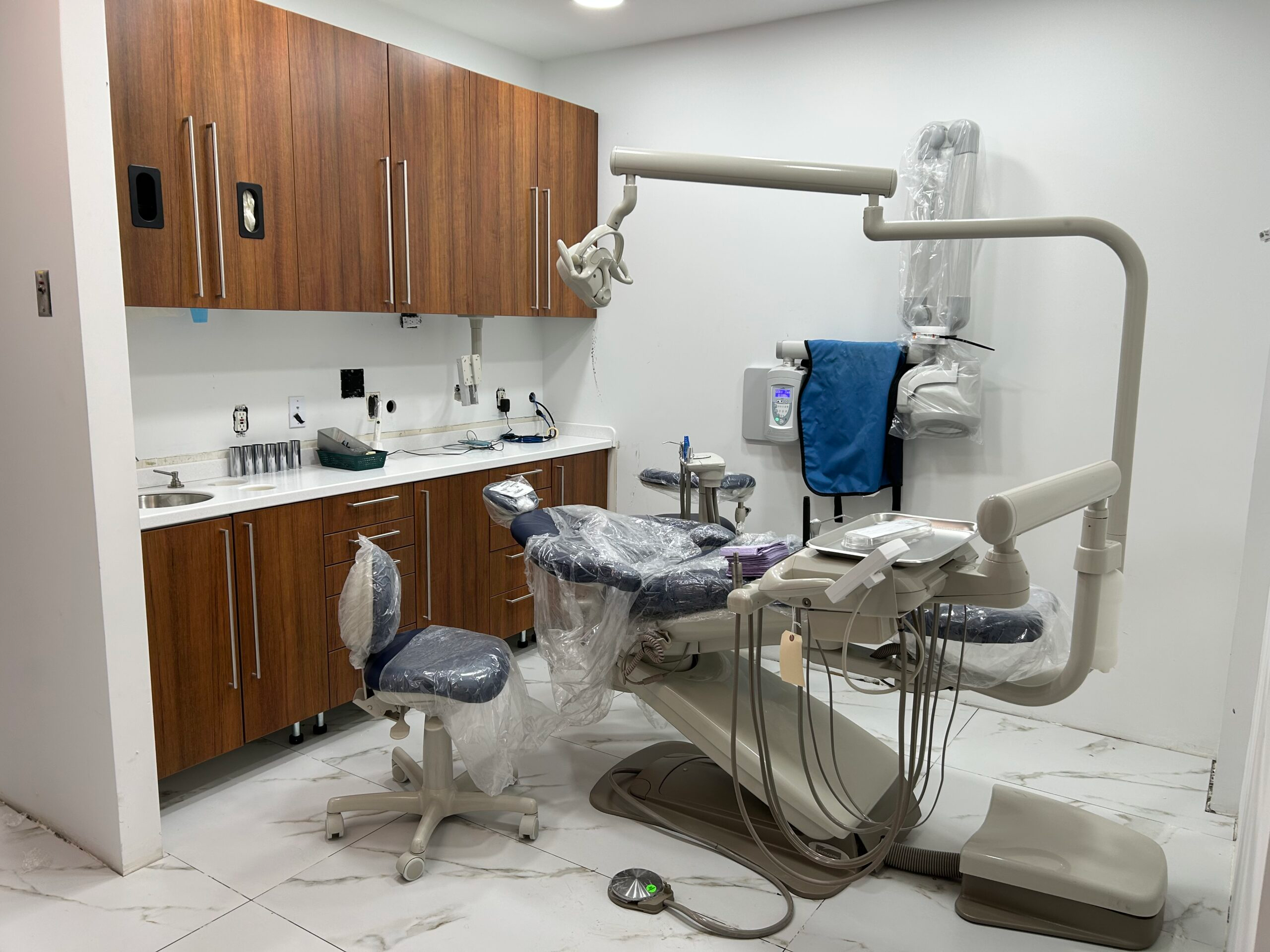
The built environment of the New York metro is unusually varied, and that variation has a direct impact on how dental practice design build contractors must approach each project. In Westchester County, the dominant commercial stock includes mid-century professional office buildings concentrated along Central Avenue in Yonkers, Route 119 in Elmsford, and the Mamaroneck Avenue corridor in White Plains. Many of these structures were built in the 1960s and 1970s with 9–10 foot finished ceiling heights — workable for dental buildouts, but requiring careful coordination when routing suction manifolds, air compressor piping, and panoramic X-ray structural anchoring within limited plenum space.
On Long Island, dental practices most often occupy one of three building types: single-tenant medical-professional buildings in communities like Melville and Hauppauge, converted residential structures in North Shore towns like Huntington and Port Washington, and strip-commercial retail bays in Nassau County corridors including Hempstead Turnpike and Merrick Road. Converted residential buildings present the greatest structural complexity — original balloon-frame or platform-frame construction rarely accommodates the 200-amp dedicated electrical service, compressed air plumbing, and nitrous oxide piping that a modern multi-operatory practice demands. Our team has executed dental buildouts in converted Victorian-era colonials on Long Island’s North Shore that required full panel upgrades, subfloor reinforcement for dental chair anchoring, and custom millwork to conceal infrastructure while preserving the streetscape aesthetic.
In New York City’s five boroughs, the architectural context shifts again. Manhattan practices frequently occupy Class A and B office towers where the dental tenant must meet the building’s own MEP (mechanical, electrical, plumbing) standards in addition to DOB requirements. Brooklyn and Queens have a dense inventory of pre-war mixed-use buildings — particularly in neighborhoods like Astoria, Flushing, Park Slope, and Williamsburg — where masonry bearing walls, cast-iron plumbing stacks, and low floor-to-floor heights require creative routing of dental infrastructure. The full scope of what dental office contractors must manage across NYC and Westchester is substantially more complex than most practice owners anticipate before their first project.
Dental Practice Owner Q&A: Real Questions from the Tri-State Region
Q: I’m opening a two-operatory startup practice in White Plains — what’s a realistic budget for a full design-build in 2026?
A: A two-operatory ground-up buildout in a Westchester professional office building currently runs between $280,000 and $420,000 fully loaded, including hard construction costs, dental equipment (chairs, delivery units, dental lights, compressor, suction), cabinetry, digital X-ray and CBCT rough-in, and soft costs like permits and design fees. The wide range reflects significant variation in cabinetry spec, equipment brands (A-dec versus Midmark versus Planmeca), and the condition of the existing shell. White Plains and Yonkers tenant improvement allowances from landlords in 2026 typically fall between $40–$65 per square foot for medical tenants, which meaningfully offsets project costs if negotiated correctly. Our team helps clients model TI allowance negotiation as part of the pre-construction phase. For detailed cost benchmarks by market, our dental office construction cost guide breaks down line-item pricing across all three regions.
Q: How long does the permit process take for a new dental office on Long Island?
A: It varies significantly by municipality. Nassau County towns like Hempstead, Oyster Bay, and North Hempstead typically process healthcare-occupancy building permits in 6–10 weeks for complete submissions, while Suffolk County can run 8–14 weeks depending on the town (Babylon and Islip tend to be faster than Riverhead). If your Long Island location requires a certificate of occupancy change — for instance, converting retail to professional medical — expect an additional 3–6 weeks for DOB site inspection and sign-off. We prepare full permit packages in-house, including architectural drawings stamped by a licensed New York State architect, MEP engineering plans, and ADA accessibility compliance documentation, which significantly reduces back-and-forth with the building department.
Q: We want to use Planmeca digital imaging equipment. Can your team handle the installation?
A: Yes — we are Planmeca manufacturer-trained, along with A-dec and Midmark certifications. This matters in practice because Planmeca’s ProMax 3D CBCT units require a dedicated lead-lined room with specific wall thickness and shielding calculations, plus digital sensor infrastructure routed at the rough-in stage. A general contractor who receives a Planmeca installation manual the week before equipment delivery is not prepared to do this correctly. Our team coordinates with the equipment manufacturer’s local rep during design development so that conduit runs, structural blocking for wall-mounted delivery systems, and electrical home-run circuits are in the right location before walls are closed. This is standard practice for us, not an afterthought.
Q: I’m relocating my existing Queens practice to a new space in Flushing — do I need to hire a separate architect and a separate contractor?
A: Not with GCMM. Our design-build model integrates architectural design, engineering coordination, permitting, and construction execution under a single contract and single point of accountability. For a practice relocation in Flushing — which involves NYC DOB filings, potential Community Board notification if signage is involved, and coordination with your outgoing and incoming landlords — having one firm manage the full scope dramatically reduces the risk of schedule delays caused by finger-pointing between separate designers and builders. We’ve managed dental practice construction across Westchester, Long Island, and NYC including multiple Queens and Brooklyn relocations with simultaneous dual-occupancy periods.
Q: What ADA compliance requirements apply to dental offices in New York State in 2026?
A: New York State adopted the 2022 IBC/ADA Standards for Accessible Design, which require that new dental construction and substantial renovations meet accessibility standards for patient routes, restrooms, reception counters, and operatory dimensions. Specifically for dental operatories, the ADA requires a 60-inch turning radius in the treatment room when the chair is positioned for patient transfer, which affects room sizing — a minimum of 11 x 14 feet is generally required for accessible compliance in a single operatory. NYC additionally requires compliance with Local Law 58 for building accessibility in existing structures. Our team includes ADA accessibility review as a standard component of design development, not an add-on fee. The ADA’s official design standards and New York State Department of Health facility design guidelines both inform our documentation process.
ROI & Investment Value: What a Design-Build Dental Practice Returns Across These Markets
Dental practice owners in the New York metro area are operating in one of the highest-value healthcare real estate markets in the country. Understanding the return on a well-executed design-build dental office is critical to making a sound business decision — and the data for Westchester, NYC, and Long Island tells a compelling story.
In Westchester County, where the median household income in communities like Scarsdale, Bronxville, and Larchmont exceeds $150,000, dental practices in Class A professional settings command significantly higher per-patient revenue than practices in outdated or poorly configured spaces. According to ADA Health Policy Institute data, practices operating in purpose-built or recently renovated environments generate 23–31% higher gross production per operatory than practices in spaces older than 15 years. A four-operatory buildout in White Plains with fully integrated digital workflow — digital impressions, CBCT imaging, intraoral cameras — typically breaks even on construction investment within 5–7 years through increased case acceptance rates and production capacity, assuming moderate patient volume growth.
On Long Island, dental practice real estate is increasingly valued as an investment asset. Nassau County commercial medical-dental properties along prime corridors in Great Neck, Manhasset, and Garden City are selling at cap rates between 5.5% and 6.5% as of Q1 2026, reflecting strong investor demand. A dental practice that owns its buildout improvements and operates in a purpose-built space can command a practice sale price of 65–80% of annual gross collections — a premium of roughly 10–15 percentage points over a practice in a generic, unimproved commercial space. Equipment that was installed by manufacturer-trained technicians (rather than general contractors unfamiliar with dental systems) also carries higher equipment resale value at the time of practice transition.
In New York City, the ROI calculus is shaped by real estate costs that are the highest in the country. Manhattan dental buildouts in Midtown, the Upper East Side, or Downtown Brooklyn involve construction costs 20–35% above the national dental construction average due to union labor requirements, high-rise logistics, and NYC-specific MEP standards. However, the patient revenue potential in these markets justifies the investment: a two-chair Manhattan specialty practice (orthodontics, oral surgery, or cosmetic dentistry) can generate $1.2–$2.0 million in annual gross collections. At those revenue levels, a $550,000 design-build investment amortizes over dental-industry-standard loan terms (7–10 years) at a monthly debt service that represents under 6% of gross revenue — a highly favorable ratio. Our team helps clients model these scenarios before committing to a space, which is part of what we mean by full-service dental practice design build.
Timeline & Planning: From Site Selection to Opening Day Across NYC, Westchester & Long Island
One of the most common mistakes dental practice owners make is underestimating how long a full design-build project takes in the New York metro. The regulatory environment here is genuinely more complex than in most other U.S. markets, and timeline management requires experience with local jurisdictions. Here is a realistic planning framework for each of our primary service areas.
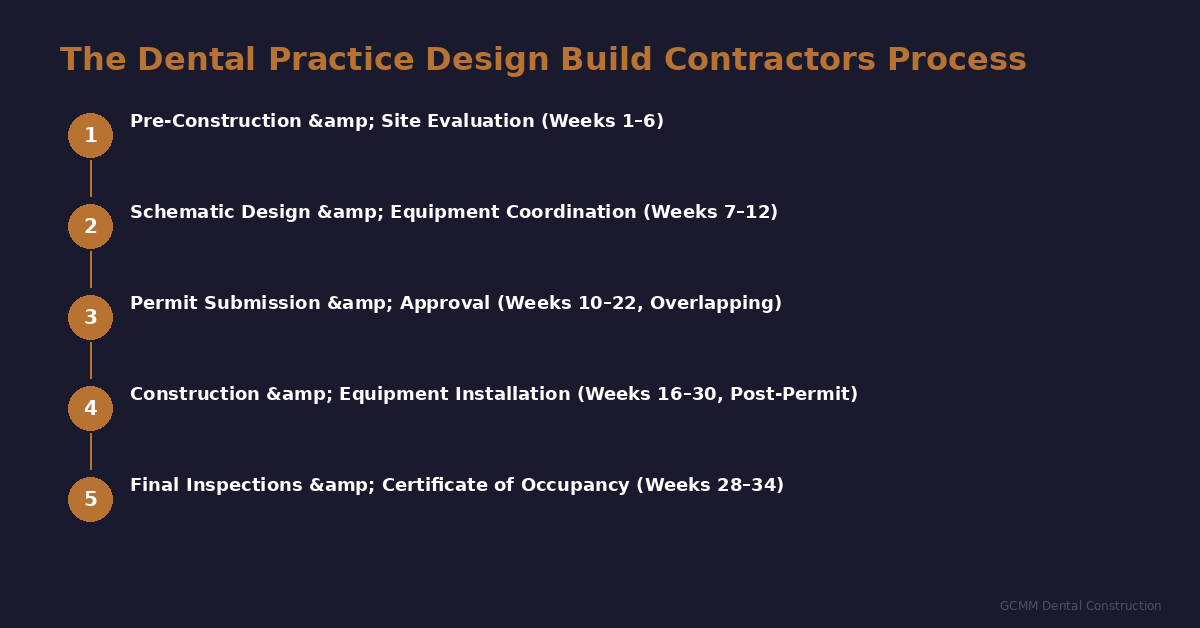
Phase 1: Pre-Construction & Site Evaluation (Weeks 1–6)
Before a single design drawing is produced, we conduct a detailed site assessment that includes existing MEP capacity review, structural evaluation, lease review for landlord approval requirements, and preliminary zoning verification. In NYC, we verify that the proposed use (professional medical/dental) is permitted as-of-right or requires a Board of Standards and Appeals variance. In Westchester, we confirm whether the municipality requires site plan approval for signage or exterior modifications. On Long Island, we verify utility service capacity, particularly for practices that will operate high-draw equipment like CBCT scanners. This phase typically takes 4–6 weeks and culminates in a signed design-build agreement with a defined project budget and schedule.
Phase 2: Schematic Design & Equipment Coordination (Weeks 7–12)
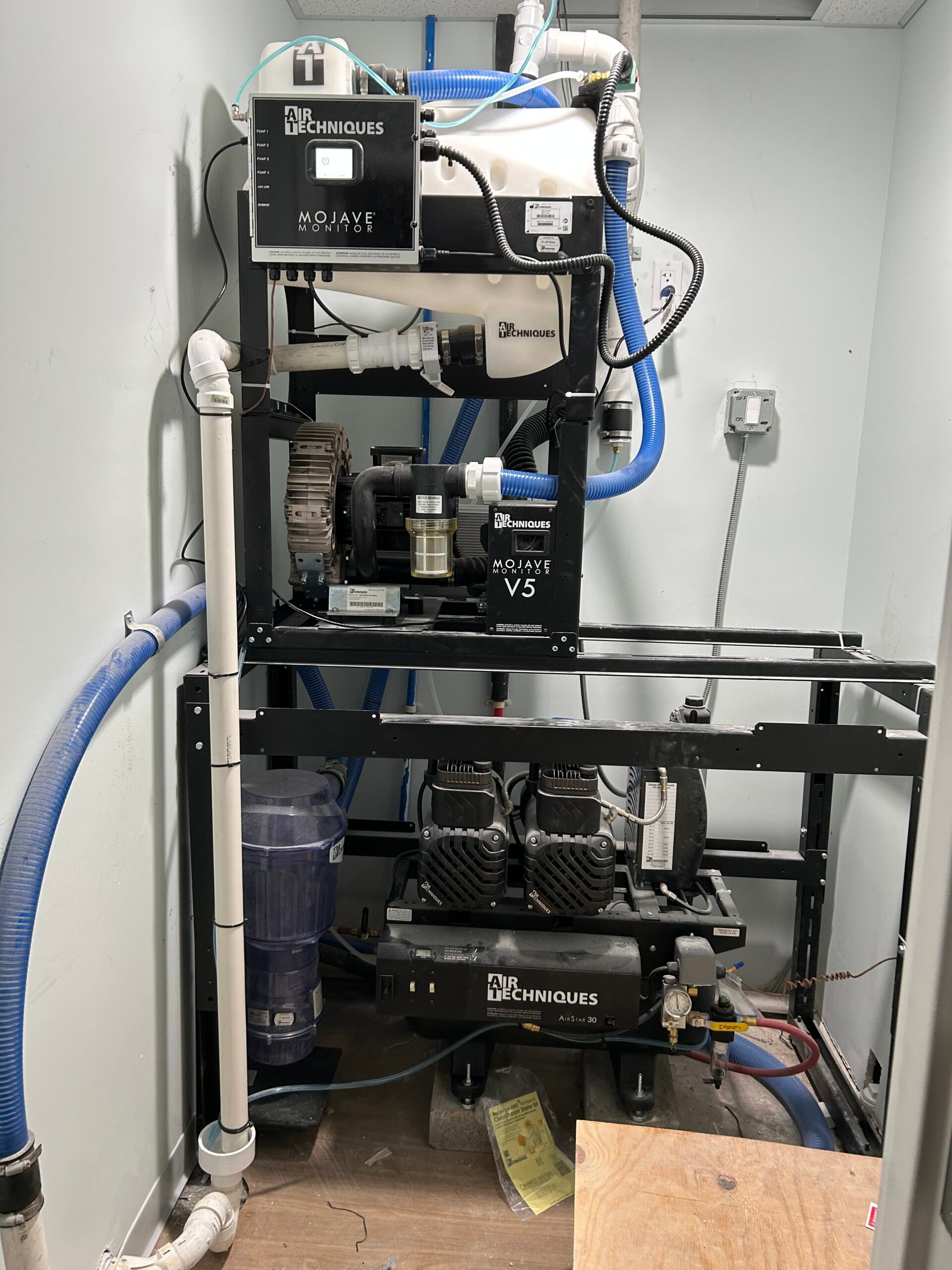
Our in-house design team produces space planning documents, operatory layouts, and equipment placement drawings in coordination with the manufacturer’s regional rep (A-dec, Midmark, or Planmeca depending on client specification). Equipment blocking dimensions, electrical loads, compressed air demand calculations, and dental vacuum system sizing are finalized during this phase. For a four-operatory practice, this typically involves a 1.5 HP oil-free compressor, a wet-ring or dry-vacuum suction system sized for simultaneous four-operatory use, and either a dedicated amalgam separator per EPA dental amalgam effluent guidelines or documentation of mercury-free protocols.
Phase 3: Permit Submission & Approval (Weeks 10–22, Overlapping)
Permit processing timelines in this region are the most variable element of any dental construction schedule. NYC DOB filings for healthcare-occupancy spaces currently average 10–16 weeks for plan examination. Nassau County runs 6–10 weeks. Westchester municipalities range from 5 weeks (White Plains, which has an online filing portal) to 12 weeks (some smaller municipalities that conduct in-person reviews). We submit complete packages — including all MEP drawings, ADA compliance documentation, and structural calculations — on the first submission to minimize re-review cycles. Understanding what separates qualified dental office contractors from general contractors is often most visible during this phase.
Phase 4: Construction & Equipment Installation (Weeks 16–30, Post-Permit)
Active construction on a three-to-four operatory dental office typically runs 10–14 weeks in our markets. Rough-in trades (electrical, plumbing, compressed air piping, suction piping) are completed in the first 3–4 weeks, followed by drywall, ceiling, and flooring. Equipment delivery is coordinated to arrive during week 8–9 of construction for chair-side installation that integrates with the millwork and utility connections already in place. Our manufacturer training means we perform the final equipment commissioning — chair calibration, delivery unit programming, suction flow testing, X-ray collimation verification — rather than waiting for a separate factory rep visit that can delay your opening by 2–3 weeks.
Phase 5: Final Inspections & Certificate of Occupancy (Weeks 28–34)
Final inspections in NYC require a DOB final inspection, Fire Department inspection for any medical gas systems, and DOHMH (Department of Health and Mental Hygiene) review if the practice is subject to clinic licensing. Long Island and Westchester require final building and plumbing inspections, plus dental board notifications. We coordinate the full inspection sequence and respond to any inspection comments on the same business day to maintain schedule momentum.
Seasonal Planning: How Climate & Timing Affect Dental Construction in the Tri-State Region
The New York metro’s four-season climate introduces real operational considerations for dental practice construction that are specific to this region and often overlooked by practice owners planning their first buildout.
Winter (December–February) is the most challenging period for projects in spaces that don’t yet have permanent heat. Dental cabinetry — particularly custom millwork with engineered wood substrates — must be stored and installed in temperature-controlled environments. Adhesives for flooring and millwork installation have minimum application temperatures (typically 55°F), and tile grout and joint compound require heat during curing. We maintain temporary heat in dental construction sites using properly vented propane heaters when necessary, but projects with significant millwork installation phases are better started by October to minimize winter-condition risk in our Westchester and Long Island projects where tenants are often responsible for building heat after hours.
Spring (March–May) is historically the most active construction start period for dental practices in this region. Practice owners who complete lease negotiations in November–January and begin design-build in February are typically positioned for a late spring or early summer completion — ideal timing because summer is often slower for dental patient volume, making it a natural period to absorb the disruption of a relocation or a parallel fit-out for a startup. New York City DOB plan examiners also tend to have shorter review queues in Q1 relative to Q3, which is historically the busiest permit application period.
Summer (June–August) brings its own challenges: NYC and Long Island experience high humidity levels that can affect drywall finishing and paint adhesion if the space is not climate-controlled. Compressed air supply line installations are particularly sensitive — air lines that are pressure-tested in summer conditions need to be re-verified in winter because thermal contraction can reveal joint weaknesses that weren’t apparent during warm-weather testing. Our commissioning protocol includes a thermal-cycle pressure test as standard practice. Summer is also when dental equipment backorders peak nationwide; A-dec, Midmark, and Planmeca all experience 10–16 week lead times on popular chair-side delivery unit configurations during peak production periods, making equipment ordering at lease signing — not at permit approval — critical for on-time openings.
Fall (September–November) is the ideal season for completing construction on practices targeting a January opening, which aligns with the new insurance year and maximizes the practice’s revenue from the first month. Westchester and Long Island practices that open in January consistently report faster new patient acquisition in the first quarter than those opening in summer, when families are less focused on scheduling dental appointments. Our team’s experience with dental office contractor services across the NYC metro informs a project schedule that is built around your intended opening date, not just a construction start date.
What Separates GCMM From General Commercial Contractors in These Markets
Manufacturer-Trained Equipment Installation
Certified by A-dec, Midmark, and Planmeca — we commission your equipment, not a separate factory rep on a 6-week wait.
Single-Contract Design-Build
Architecture, engineering, permitting, construction, and equipment installation under one agreement and one schedule.
ADA Compliant Documentation
Every project includes a formal ADA accessibility compliance review and as-built documentation for your Certificate of Occupancy file.
Local Permit Expertise
We navigate NYC DOB, Nassau and Suffolk County, and Westchester municipal filings — not a learning experience on your project.
Dental-Specific MEP Engineering
Compressed air systems, dental vacuum, amalgam separation, nitrous oxide piping, and lead shielding calculations are standard, not optional add-ons.
Tri-State Market Pricing Transparency
Detailed line-item budgets for Westchester, NYC, and Long Island — no regional pricing surprises mid-project.
Dental practice owners across Westchester, New York City, and Long Island face a market where the difference between a properly executed design-build and a problematic one often comes down to contractor specialization. A general contractor who has never routed a dental vacuum manifold, never calculated compressed air demand for a four-operatory load, and never coordinated with a DOB plan examiner on healthcare-occupancy X-ray room shielding calculations is going to learn those lessons on your project — and the tuition is paid in delays, change orders, and re-work. Our team at GCMM Dental Construction has built that expertise specifically so our clients don’t have to pay that cost. Visit gcmmdentalconstruction.com to review our project portfolio and request a consultation for your Westchester, NYC, or Long Island dental practice design build project, or reach our team directly at (347) 961-7357 or gary@gcmm.nyc.
“`
Ready to Get Started?
Contact GCMM Dental Construction today for a free consultation and personalized quote.
Phone: (347) 961-7357 | Email: gary@gcmm.nyc