
Book Appointment Now
dental office contractors
dental office contractors. Expert insights from GCMM Dental Construction. Call (347) 961-7357 for your project.
Dental Office Contractors Westchester NYC & Long Island
Picture the morning commute along the Bronx River Parkway as it winds through White Plains, or the steady hum of medical corridors in Midtown Manhattan, or the suburban commercial strips of Hauppauge and Garden City where new dental practices open their doors every season. Across the tri-state region — from Yonkers and Scarsdale to Forest Hills in Queens, from Huntington to Hicksville — dentists are building, expanding, and reimagining their clinical spaces at a pace that demands contractors who understand far more than drywall and electrical rough-ins. At GCMM Dental Construction, we are those dental office contractors. Based in the Bronx at 876 Kinsella St and working throughout Westchester, New York City, and Long Island, our team brings a level of clinical construction expertise that generalist contractors simply cannot match.
The Architectural Landscape of Our Service Region — and Why It Matters for Dental Construction
Understanding the built environment of Westchester, New York City, and Long Island is the first step toward building a functional, code-compliant dental office. These three regions are architecturally distinct, and each one presents its own set of structural realities that directly shape how we approach a dental buildout.
In Westchester County, the commercial real estate stock is a mix of mid-century medical office parks — the kind you’ll find clustered near White Plains Medical Center along Maple Avenue or in the professional corridors of New Rochelle — and converted Victorian-era storefronts in village centers like Hastings-on-Hudson or Dobbs Ferry. Many of these buildings date to the 1930s through 1960s, which means we routinely encounter knob-and-tube-era wiring that needs full replacement, cast-iron waste lines that require re-routing to accommodate new wet-lab plumbing, and ceiling heights of 8 to 9 feet that challenge our mechanical coordination between dental unit waterline runs, HVAC ductwork, and overhead cabinetry. Westchester also falls under a patchwork of local codes: White Plains Building Department requirements differ from those in Yonkers or Ossining, and zoning for dental use must be confirmed in each municipality before we begin design work.
In New York City, the challenge is vertical density. Most dental practices open in Class B or Class C office buildings in neighborhoods like Flushing, Astoria, Bay Ridge, and the Bronx’s Grand Concourse corridor. These spaces frequently involve shared mechanical chases, building management approval for any penetrations into floor slabs, and NYC DOB permit coordination that adds 4–8 weeks to a typical project timeline. NYC Local Law 97, which governs carbon emissions from buildings over 25,000 square feet, increasingly factors into the mechanical systems we specify for large multi-operatory buildouts. We navigate all of it — working with expeditors when necessary and maintaining strong relationships with NYC DOB plan examiners who review dental-specific projects.
On Long Island, dental practices typically occupy single-story or two-story commercial strip buildings and medical office condominiums in communities like Commack, Massapequa, and Valley Stream. The sprawl-era construction of the 1970s and 1980s means lower ceilings, older MEP infrastructure, and HVAC systems sized for general office use — all of which require significant reconfiguration to support the power, vacuum, and compressed air demands of modern dental equipment. Nassau and Suffolk County both have active building departments with specific requirements for medical occupancy, and many municipalities require fire suppression system upgrades when a space changes occupancy classification from general office to healthcare.
Our familiarity with dental practice construction across Westchester, Long Island, and NYC means we walk into every lease negotiation armed with the structural knowledge to evaluate a space before you sign — saving clients from costly surprises six months into a buildout.
Local Project Spotlight: A Three-Operatory Practice Build in White Plains, Westchester
One of the projects we’re most proud of in recent years began with a phone call from an endodontist who had just signed a lease on the second floor of a 1962 medical office building on Mamaroneck Avenue in White Plains — a high-traffic location with strong patient visibility but a space that had been vacant for two years and last occupied by a dermatology group.
The Scope
The buildout called for three fully plumbed treatment operatories, a dedicated sterilization room with dual autoclave stations, a digital panoramic X-ray alcove, a private consultation room, a front reception and waiting area with ADA-compliant check-in counter, and a staff break room. Total buildable square footage: approximately 1,640 SF. The existing layout had a single central bathroom, no medical gas rough-in, and a 100-amp electrical service that hadn’t been touched since the Carter administration.
The Challenges
The most significant challenge was the building’s cast-iron plumbing stack. The new sterilization room and operatory wet areas needed to drain to a common amalgam separator before reaching the municipal system — a requirement under EPA dental effluent guidelines that many generalist contractors don’t even know exists. Routing new PVC drain lines to the stack while maintaining proper slope in a 9-foot ceiling environment required precision coordination between our rough plumbing crew and the ceiling soffit framing. The electrical panel upgrade to 200-amp three-phase service required Consolidated Edison coordination, which in Westchester adds a 3–5 week lead time to the project schedule. We flagged this on day one and placed the utility order before we broke ground.
The Timeline and Outcome
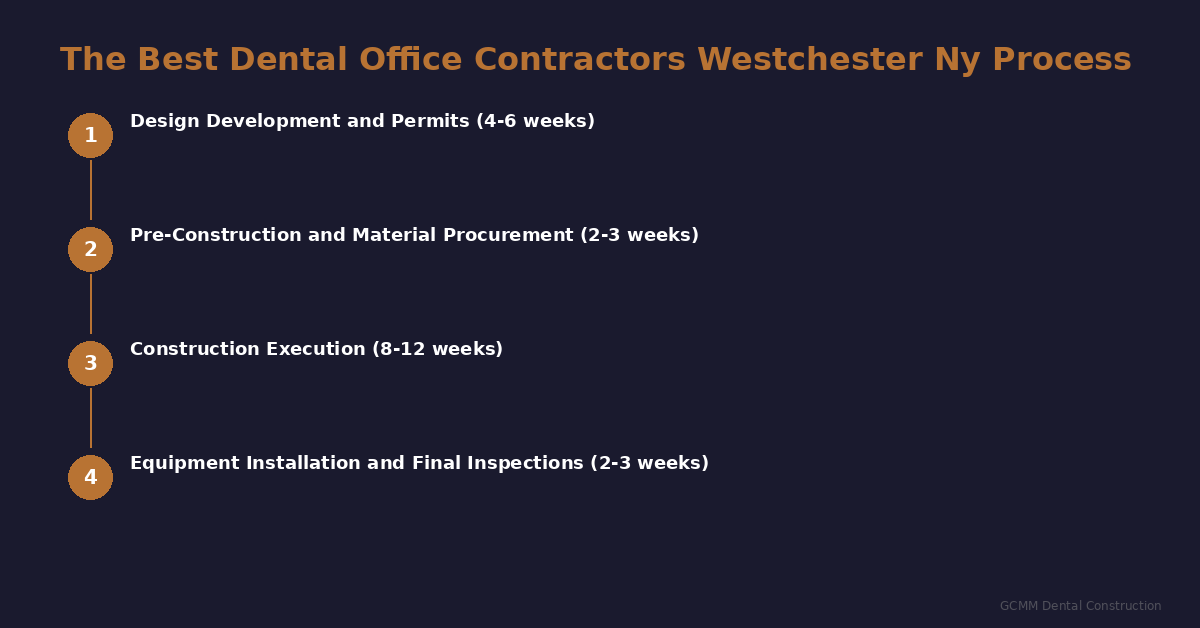
Permitting through White Plains Building Department took 5 weeks — we submitted a complete set of architectural and MEP drawings prepared with the practice’s equipment layout pre-coordinated. Construction ran 11 weeks. The practice opened on schedule with three fully operational Midmark Elevance treatment chairs, an A-dec delivery system configuration, and a Dentsply Sirona ORTHOPHOS SL panoramic unit mounted in a purpose-built lead-lined alcove. The client was seeing patients 16 weeks after signing the lease — a timeline that competing contractors had quoted at 6 months or more.
Before and After: From Vacant Insurance Office in Flushing to Thriving Pediatric Dental Practice
Before we touched it, the space on Main Street in Flushing, Queens was a cautionary tale in failed commercial tenancy — drop ceilings with water-stained tiles, fluorescent tube lighting on outdated ballasts, linoleum flooring peeling at the seams, and a bathroom positioned directly where the pediatric dental practice’s sterilization room needed to be. The landlord had offered a $75-per-square-foot tenant improvement allowance on a 1,900 SF space, which sounded generous until we walked through and identified the extent of what needed to come out before anything could go in.
The Demolition Discovery
Demo week revealed what the inspection hadn’t: a prior tenant had run a non-permitted sub-panel off the main electrical room, creating a fire hazard that required immediate remediation before the NYC DOB would continue the permit process. The existing HVAC ductwork ran perpendicular to our planned operatory layout, meaning a full re-duct was necessary rather than the partial modification we had hoped for. And the concrete slab had a 3-inch differential in elevation from the front of the space to the rear — something only visible once the old flooring was stripped — which required a self-leveling pour before we could lay the new luxury vinyl plank.
The Build
We designed the space around five pediatric operatories positioned along the exterior wall to maximize natural light — a detail that matters enormously in pediatric practice design, where a calming environment reduces patient anxiety. Each operatory received our standard dental rough-in package: dedicated 20-amp circuits for the unit and chair, compressed air at 90 PSI with 3/8-inch copper hard-piped from the compressor room, vacuum at 10 inches Hg sustained, and hot/cold water with proper backflow prevention at the dental unit junction. The sterilization room was built out with an Ultrasound cassette washer station, dual Midmark M11 autoclave cavities, and an instrument tracking pass-through window to the operatory corridor — a workflow detail that pediatric practices with high patient volume particularly benefit from.
The Transformation
Fourteen weeks later, where there had been stained drop ceilings and peeling linoleum, there was a pediatric dental practice that felt like it had been designed by an architect who actually understood infection control, equipment workflow, and the psychology of treating young patients. The waiting area featured a custom built-in play station framed into the millwork, the reception desk was positioned for direct sightlines to both the entry door and the operatory corridor, and every surface material — from the seamless LVT flooring to the epoxy-painted sterilization room walls — was specified for cleanability and durability. The practice owner told us it was the best professional investment of her career. We believe her.
The Return on Investment: What a Professional Dental Buildout Delivers in This Market
Westchester County’s commercial real estate market has remained resilient through recent economic cycles, with Class B medical office space in White Plains and Yonkers averaging $28–$38 per square foot annually as of early 2026. On Long Island, medical office rents in Nassau County submarkets like Garden City and Mineola run $30–$42 PSF, reflecting strong demand from healthcare tenants. In New York City’s outer borough markets — Flushing, Bay Ridge, Parkchester — dental practices operate in spaces ranging from $35 to $60 PSF depending on ground-floor visibility and proximity to subway or LIRR transit nodes.
In this context, the question isn’t whether you can afford to build out your dental office properly — it’s whether you can afford not to. A well-executed buildout by qualified dental office contractors directly affects three financial outcomes: your ability to command premium fee schedules, your practice’s valuation at sale or partnership buy-in, and your operational efficiency over a 10–15 year lease term.
Practice Valuation Premium
Dental practices in the New York metro area typically sell at 60–80% of gross annual collections. A practice operating in a well-designed, properly equipped space — versus one in a dated, inefficient buildout — commands the higher end of that range. On a practice collecting $1.2 million annually, that’s a valuation difference of $240,000 or more.
Operational Efficiency Gains
An operatory designed around proper ergonomic workflow — with delivery system positioning, assistant reach zones, and cabinetry heights specified to clinical standards — reduces chair time per procedure. For a busy general practice turning four chairs, even a 10% improvement in procedure efficiency translates to significant annual revenue gains.
Equipment Longevity
Dental chairs and delivery systems installed by our A-dec and Midmark-trained technicians, with proper rough-in pressures, correct waterline materials, and appropriate electrical protection, routinely achieve 15–20 year service lives. Improperly installed equipment — particularly vacuum and compressor systems — often requires major service or replacement within 5–7 years.
Avoiding Costly Retrofits
We regularly see practices that hired the cheapest contractor available and now face $40,000–$80,000 in remediation costs: non-compliant amalgam separators, under-powered electrical panels, improperly sloped drain lines, or ADA access violations discovered during a DOH inspection. Building it right the first time is always less expensive.
For a detailed breakdown of what typical dental office construction investments look like in this market, our dental office construction cost guide for the NYC area covers the full range of buildout scenarios with real cost data.
Town-Specific Construction Challenges Across Our Service Region
Every region in our service area presents a distinct set of construction realities that would catch an unprepared contractor off guard. Our team has spent years navigating these challenges, and we want to give you a candid picture of what they are — because informed clients make better decisions about their buildout partners.
Westchester: Aging Building Stock and Municipal Permit Complexity
The biggest recurring challenge in Westchester is the age of the commercial building stock. Buildings constructed before 1980 in communities like Mount Vernon, Ossining, and Peekskill frequently contain asbestos-containing materials in floor tile adhesives, pipe insulation, and ceiling tile — materials that trigger New York State asbestos abatement requirements before any demolition work can begin. This adds 2–4 weeks and $8,000–$25,000 to a project depending on the extent of ACM present. We conduct pre-demolition surveys on every Westchester project and factor abatement into our initial project schedules — not as a surprise change order.
Westchester also has no unified building code administration. Each of the county’s 45 municipalities — cities, towns, and villages — operates its own building department with its own permit review timelines and inspector schedules. White Plains is generally efficient; some of the smaller village departments may take 6–10 weeks for plan review on a medical occupancy application. We know which municipalities require pre-application meetings, which ones need fire marshal sign-off before permit issuance, and which ones can be navigated efficiently with a well-prepared submission package.
New York City: Building Management, DOB Coordination, and Landmark Considerations
In New York City, the single greatest source of dental buildout delays is not the NYC Department of Buildings — it’s the building’s management company. Co-op and condo buildings with ground-floor or second-floor commercial units (common in neighborhoods like Riverdale, Forest Hills, and Park Slope) often require board approval for any work that touches the building’s mechanical systems or structural elements. We’ve seen board approval processes take 8–12 weeks. For clients looking at spaces in landmarked buildings or historic districts — not uncommon in neighborhoods like Brooklyn Heights or the Upper West Side — façade modifications and even some interior work may require Landmarks Preservation Commission review.
NYC also requires licensed master plumbers and licensed electricians for all permit-required work, and dental offices almost always trigger permit requirements due to the gas piping, compressed air systems, and electrical demand. We maintain active subcontractor relationships with licensed NYC master plumbers and electricians who understand the dental-specific scope — they’re not learning what an amalgam separator is on your job.
Long Island: Slab Construction, HVAC Sizing, and Fire Suppression Requirements
Long Island’s commercial building stock — particularly the strip centers and professional office parks that dominate communities like Commack, Bohemia, and Farmingdale — presents a different set of challenges. Most of these buildings are slab-on-grade construction, which means all plumbing must run overhead rather than below the floor. For a dental office, this affects the routing of drain lines from operatory wet areas and requires careful coordination between ceiling height, equipment height, and the drainage slope required to maintain proper flow to the waste stack.
Many Long Island municipalities — particularly in Nassau County — require full wet-pipe fire suppression systems when a space changes from general office to medical/healthcare occupancy. This is a significant cost item (typically $15,000–$35,000 for a 1,500–2,500 SF dental suite) that must be budgeted and permitted before construction begins. We identify this requirement during our initial space evaluation so clients can factor it into lease negotiations for tenant improvement allowance.
For more context on what makes an experienced dental contractor the right choice for these complex regional requirements, our guide on what to look for in a dental office contractor in the NYC area walks through the key qualification criteria in detail.
Why Dentists from Yonkers to Huntington Choose GCMM Dental Construction
Our team holds active manufacturer training certifications from A-dec, Midmark, and Planmeca — three of the most widely specified dental equipment manufacturers in the Northeast. This isn’t a marketing credential; it’s a functional advantage that shows up in how we rough-in a space. When we build an operatory for a Midmark Elevance chair, we know the exact electrical specification, the compressed air inlet size and pressure requirement, the vacuum line diameter, and the water inlet configuration — because we’ve been trained by the people who engineer the equipment. When an A-dec delivery system needs a specific blocking pattern in the cabinetry wall, we know exactly where to frame that blocking before the drywall goes up.
This level of equipment integration knowledge is what separates our work from that of general commercial contractors who build dental offices the same way they build law offices — with a vague understanding that there will be “some plumbing and electrical” involved. Dental construction is a distinct trade, and we’ve built our entire company around mastering it.
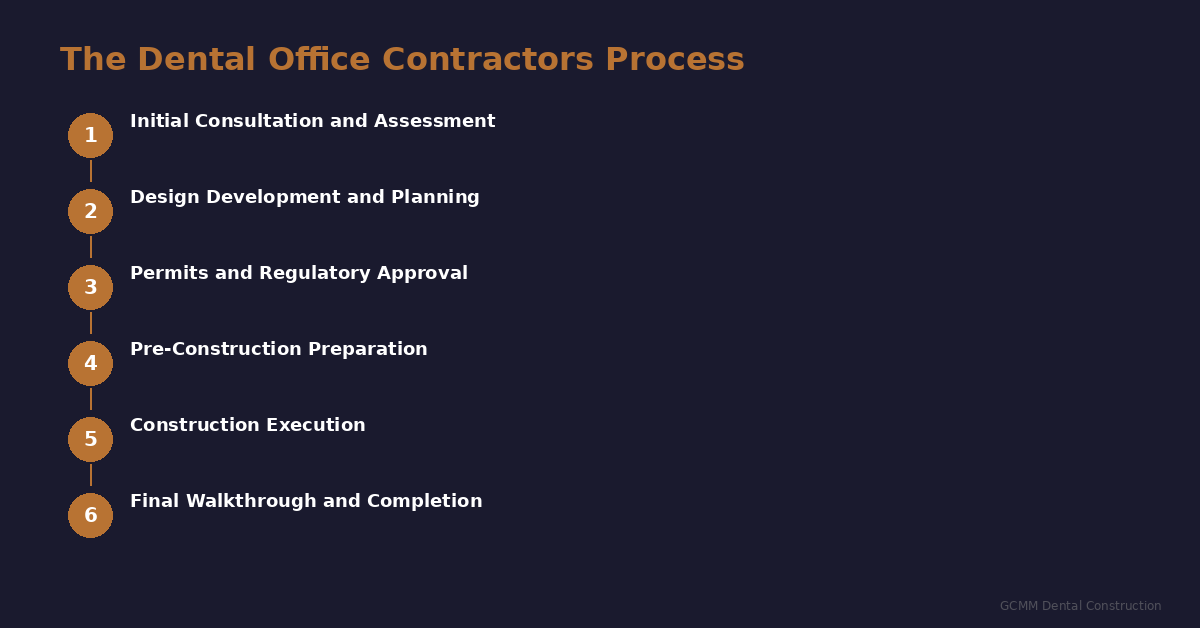
As dedicated dental office contractors serving NYC, Westchester, and Long Island, we deliver full-service project management from initial space evaluation and lease review support through permit acquisition, construction, equipment installation, and final inspection sign-off. Our clients don’t coordinate between separate architects, engineers, and contractors — we manage the entire process under one roof.
How long does a typical dental office buildout take in Westchester or Long Island?
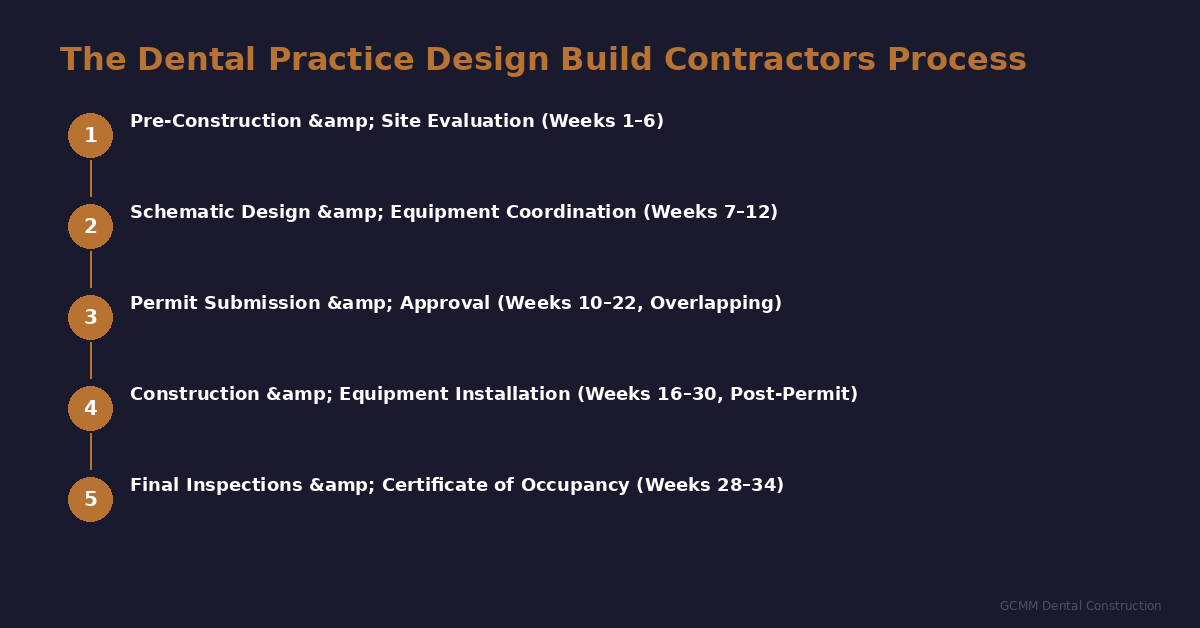
Most dental office buildouts in our region run 12–18 weeks from permit approval to certificate of occupancy, depending on the scope and complexity of the space. In Westchester, plan review typically adds 4–8 weeks to the pre-construction timeline; NYC DOB review can run 6–10 weeks for new medical occupancy applications. Long Island municipalities vary considerably — Nassau County towns generally move faster than some Suffolk County departments. We build these permit lead times into our project schedules from day one, so clients always have a realistic picture of their total project timeline before signing a lease.
What is the typical cost range for a dental office buildout in the NYC metro area?
For new dental office construction in New York City, Westchester, and Long Island, full buildout costs (excluding equipment purchase) typically range from $150 to $275 per square foot depending on the condition of the base space, the number of operatories, and the level of finishes specified. A three-operatory practice in a white-box space in White Plains or Hauppauge might run $200–$225 PSF, while a similar scope in Manhattan or a building requiring significant mechanical upgrades could approach $275 PSF or higher. Our NYC dental office construction cost guide provides a more detailed breakdown.
Do you handle ADA compliance for dental office buildouts?
Yes — ADA accessibility compliance is integrated into every project we design and build. For dental offices in New York, this means accessible parking and building entry, compliant reception counter heights (no higher than 36 inches at the service section), accessible restroom configuration, operatory doorways at minimum 32-inch clear width, and proper maneuvering clearances throughout the clinical area. We’ve seen practices receive DOH inspection violations for ADA deficiencies years after a buildout — issues that a properly prepared contractor would have addressed in the original construction documents. We build to the 2010 ADA Standards as the baseline, then layer on any state or local amendments.
Can you work with our equipment vendor, or do we need to use your equipment sources?
We work seamlessly with any dental equipment vendor your practice selects. Our manufacturer certifications with A-dec, Midmark, and Planmeca reflect our technical training, not an exclusive supply arrangement. If your practice has a preferred equipment dealer in the tri-state area, we coordinate directly with their installation team on rough-in specifications, delivery scheduling, and final commissioning. In our experience, the best outcomes come when the equipment dealer, the construction contractor, and the practice owner are communicating together from the space planning phase — before any walls go up and certainly before any rough-in work is done.
What separates GCMM Dental Construction from other dental office contractors in the region?
The most honest answer is specificity. General commercial contractors who occasionally build dental offices don’t know what they don’t know — and in dental construction, the details matter enormously. An improperly sized vacuum system that loses flow at four simultaneous users, a compressed air line with the wrong pipe size causing pressure drop during peak demand, an amalgam separator installed without proper access for filter changes — these are the kinds of mistakes that cost practices money and headaches for years. Our team has built dozens of dental offices across Westchester, New York City, and Long Island, and we’ve learned every lesson there is to learn about what dental construction requires. That institutional knowledge is what we bring to every project, and it’s why dentists who’ve worked with us refer their colleagues to us consistently.
How do I get started with GCMM Dental Construction?
The best first step is a conversation. Call us at (347) 961-7357 or email gary@gcmm.nyc to schedule a free initial consultation. If you have a space in mind, we’ll walk through it with you and provide an honest assessment of the buildout potential, the likely permit path, and a preliminary budget range — all before you’ve committed to anything. If you’re still in the site selection phase, we can help you evaluate candidate spaces against your equipment and operatory count goals so you make the right lease decision from the start. We serve the entire region from our base in the Bronx, with active projects running across Westchester, NYC, Long Island, New Jersey, and Connecticut.
From the medical office corridors of White Plains to the transit-adjacent commercial blocks of Flushing, from the strip center suites of Commack to the co-op storefronts of Riverdale, GCMM Dental Construction brings the same depth of dental construction expertise to every project. If you’re planning to open, expand, or relocate your dental practice anywhere in Westchester, New York City, or Long Island, we are the dental office contractors who understand your clinical requirements, navigate your local permit environment, and deliver a finished space that works the way a dental practice actually needs to work. Reach our team today at (347) 961-7357 or explore our full scope of services at gcmmdentalconstruction.com.
Ready to Get Started?
Contact GCMM Dental Construction today for a free consultation and personalized quote.
Phone: (347) 961-7357 | Email: gary@gcmm.nyc