
Book Appointment Now
Best Dental Office Contractors
Best Dental Office Contractors. Expert insights from GCMM Dental Construction. Call (347) 961-7357 for your project.
Planning a Dental Office Buildout in Westchester NY?
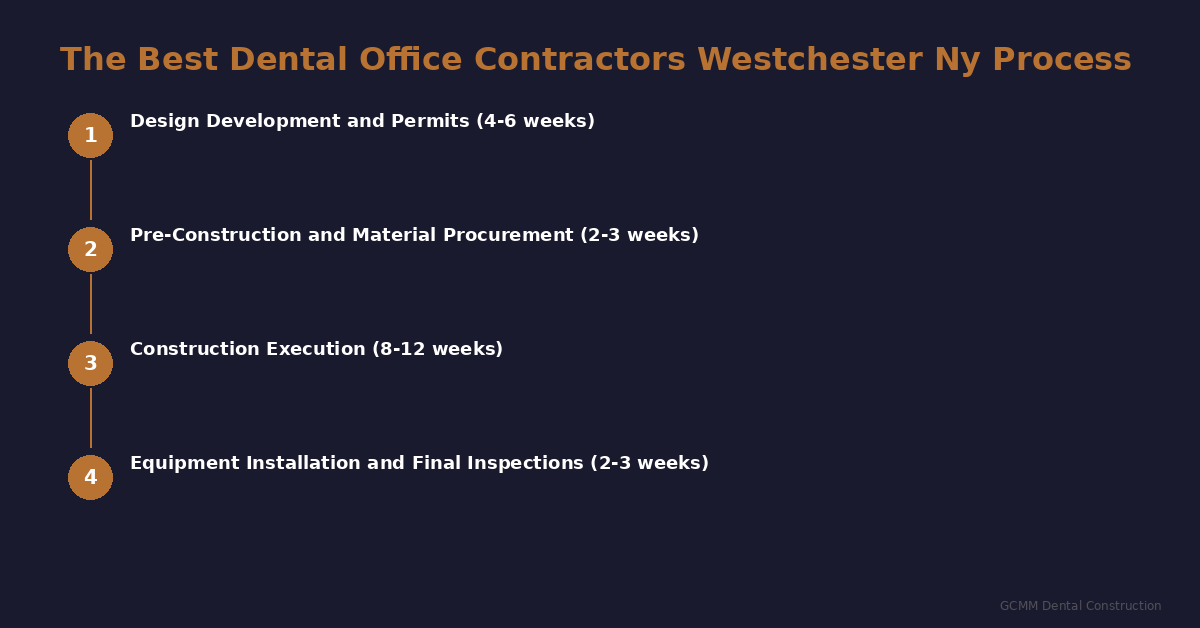
Looking for best dental office contractors westchester ny? Every dental office buildout in Westchester starts with the same moment: you’ve found a space, you’ve signed or you’re about to sign a lease, and now you need a contractor who actually understands what goes into building a dental practice — not just walls and wiring, but the equipment rough-ins, the medical gas compliance, the infection control zoning, and the dozen other details that general commercial contractors don’t know to plan for until they’re already behind schedule.
Professional Best Dental Office Contractors Westchester NY
We hear the same story from dentists across the county. They get bids from two or three general contractors, the numbers look reasonable, but nobody can tell them the correct rough-in dimensions for their chair packages, nobody has pulled a dental-specific permit in Westchester before, and nobody mentions the zoning overlay districts that require additional site plan review before construction can start. That’s where we come in. We’re GCMM Dental Construction, and navigating exactly that kind of situation — in Westchester, the Bronx, NYC, Long Island, New Jersey, and Connecticut — is what we do every single day. Before starting GCMM, our founder worked at Benco Dental as an equipment technician, receiving hands-on manufacturer training from A-dec, Midmark, Planmeca, Air Techniques, Vatech, and DCI. That means we don’t just build rooms — we build rooms specifically designed for the equipment that goes in them. If you’re looking for the best dental office contractors in Westchester NY, this page walks through every piece of the puzzle you’ll face.
How Westchester’s Seasons and Climate Shape Your Dental Office Timeline
Westchester County sits in a humid continental climate zone — and if you’ve lived or worked here for any length of time, you know that reality plays out in ways that directly affect construction schedules. Spring thaw typically arrives in late March or early April, but the ground can stay saturated through May, which matters if your project involves any below-grade utility work or if you’re building in a mixed-use development where shared parking lots get churned up during heavy equipment staging.
Our best dental office contractors westchester ny team specializes in creating functional, code-compliant spaces tailored to your practice.
Summer in White Plains, New Rochelle, or Tarrytown brings its own complications. Humidity regularly sits above 70% from June through August, and that moisture content in the air affects drywall curing times, joint compound drying schedules, and the performance of flooring adhesives on slab-on-grade spaces. We account for these conditions in our project sequencing — for instance, we typically schedule drywall finishing and painting phases for early morning start times during summer months, and we use commercial-grade dehumidifiers in spaces that aren’t yet climate-controlled. This isn’t a minor detail. A rushed drywall finish in a humid Westchester summer can lead to micro-cracking that shows up three months after you open your doors.
Winters here are genuinely cold — average January lows hover around 22°F, and the stretch from late November through mid-March is when you’ll see the most schedule pressure. Dental office buildouts involve a significant amount of mechanical work: medical-grade compressed air lines, vacuum systems, nitrous oxide plumbing, and in many cases hydronic radiant heat. All of that rough-in work needs to happen before insulation and drywall, and in a Westchester winter, unheated spaces require temporary heating equipment to keep pipe connections from freezing before they’re pressure-tested. We bring in temporary construction heaters as standard practice on winter projects, which keeps your schedule on track instead of discovering a failed solder joint in February.
The smart move for most Westchester dental practices is to target a construction start between late September and early November, or in the April-to-May window. You get past summer humidity, you’re ahead of the holiday scheduling crunch, and your equipment installation phase lands in a temperature-stable environment. We help every client think through this calendar during the initial planning conversation — before contracts are signed.
The Unique Construction Challenges Westchester Dentists Actually Face
Westchester County is not a monolithic real estate market. The building stock ranges from 1920s Tudor-style commercial buildings on Mamaroneck Avenue in White Plains, to 1960s-era medical office buildings in Harrison and Scarsdale, to brand-new mixed-use developments going up along the MetroNorth corridor in Tarrytown and Dobbs Ferry. Each building type presents genuinely different construction scenarios, and the contractor who did a clean buildout in a 2010 Harrison office park is not necessarily equipped to handle the electrical infrastructure realities in a pre-war Yonkers storefront.
Here are the specific challenges we encounter most often across Westchester:
- Outdated electrical service in older buildings: Many commercial spaces in Yonkers, Mount Vernon, and older sections of White Plains are running 100-amp or 200-amp single-phase service. A fully equipped dental office with four operatories, sterilization equipment, a digital panoramic X-ray unit, and HVAC typically needs a minimum 400-amp three-phase service. Coordinating a service upgrade with Con Edison in Westchester adds 6–10 weeks to your permitting and rough-in timeline. We identify this in our pre-construction assessment so it doesn’t blindside you two months into the job.
- Concrete slab penetrations in first-floor spaces: Dental operatories require floor penetrations for chair utility connections — vacuum, air, water, and electrical. In ground-floor spaces with poured concrete slabs, this means core drilling, which has to be coordinated with structural drawings. In Westchester’s older mixed-use buildings, original structural drawings often don’t exist, which means a structural engineer needs to assess the slab before any cutting begins.
- HVAC and ventilation in multi-tenant buildings: The infection control requirements for dental operatories — including proper exhaust rates and negative pressure considerations in sterilization areas — often conflict with the shared HVAC configurations common in Westchester’s suburban office buildings. We’ve worked through this in buildings across Fleetwood, Bronxville, and other areas where building management agreements had to be amended to allow dedicated exhaust runs.
- Accessibility in buildings without elevators: A substantial portion of Westchester’s small commercial and medical office buildings are two- and three-story walk-ups, particularly in downtown New Rochelle and downtown Ossining. ADA accessibility compliance for second-floor dental practices in these buildings is a nuanced issue that requires early coordination with the building department and sometimes involves variances or equivalent facilitation documentation.
For a deeper look at how we navigate contractor selection based on these building types, see our guide on what to look for in a dental office contractor — it covers the specific questions you should be asking before you sign a construction agreement.
What a Westchester Dental Office Buildout Actually Costs in 2026
Let’s talk numbers honestly, because vague cost ranges don’t help you plan a real project. The Westchester commercial construction market sits at a meaningful premium over national averages — and slightly above Long Island pricing in most categories — due to the combination of union labor prevalence, high material delivery costs relative to the NYC metro supply chain, and the premium that Westchester landlords place on medical and dental tenants (which often translates to less generous tenant improvement allowances than you’d see in suburban New Jersey or Connecticut).
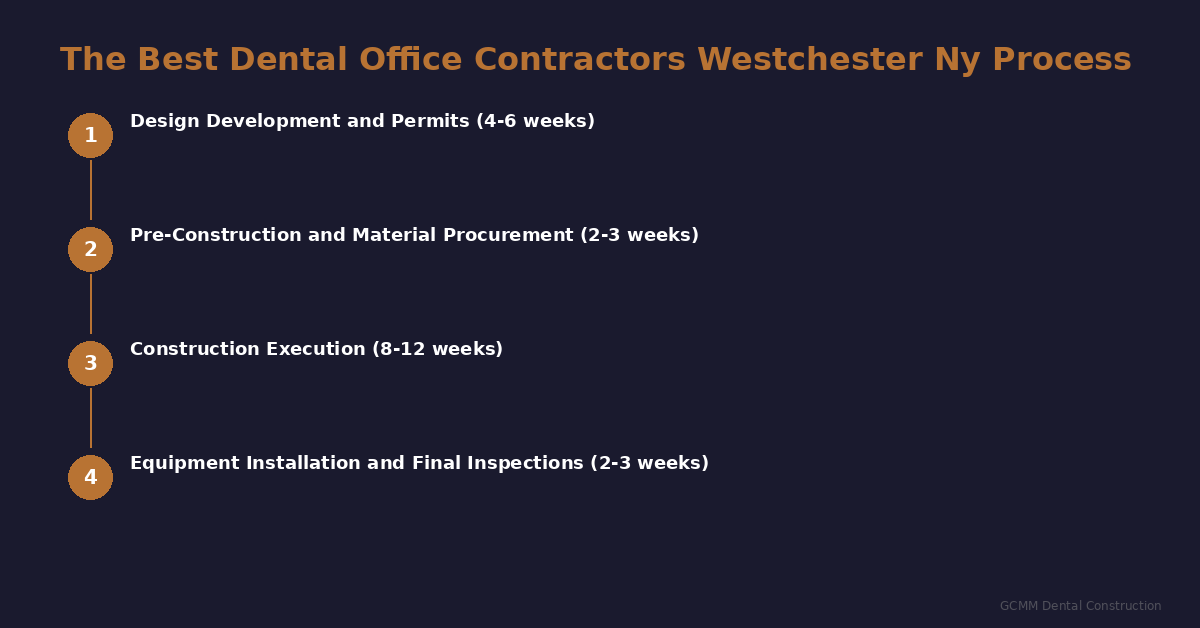
Here’s a realistic breakdown of what dental office buildouts cost in Westchester County in 2026:
- Tenant improvement / ground-up buildout (vanilla box to finished dental office): $175 to $230 per square foot, depending on operatory count, material finishes, and existing MEP conditions. A 2,000-square-foot, four-operatory practice in White Plains or Scarsdale typically runs $350,000–$460,000 in construction costs before equipment.
- Equipment procurement and installation: A fully equipped operatory with A-dec or Midmark chair package, delivery unit, light, and cabinetry runs $35,000–$55,000 per operatory installed. This is separate from construction costs and is where our manufacturer training from A-dec, Midmark, and Planmeca directly protects your investment — improperly seated delivery unit connections and incorrect vacuum line sizing are the most common (and most expensive) mistakes made by general contractors handling dental equipment for the first time.
- Renovation of an existing dental space: If you’re taking over a space that was previously a dental practice — which happens fairly often in established Westchester communities like Ardsley, Elmsford, and Pelham — renovation costs typically run $80–$140 per square foot depending on how much of the existing infrastructure is reusable. A dated 1990s practice with single-phase vacuum systems and pre-digital X-ray plumbing often needs more remediation than it looks like on first inspection.
For a comprehensive breakdown of how construction pricing is structured across the NYC metro region, our dental office construction cost guide covers line-item categories in detail. Westchester projects consistently run 8–15% above the NYC baseline due to suburban trade labor rates and logistics costs.
One cost factor that surprises many Westchester dentists: landlord-provided tenant improvement allowances in Westchester typically range from $40–$75 per square foot for medical tenants — well below the $100–$150+ you might see in Class A Manhattan buildings. That gap has to come from somewhere in your financing plan, and we help clients structure construction scopes strategically to maximize what the TI allowance covers.
Westchester Building Permits and Code Compliance: What You Need to Know
This is where a lot of dental office projects go sideways, and it’s where our experience in Westchester County pays dividends for our clients. Westchester is not a single jurisdiction — it’s a county containing 45 municipalities, each with its own building department, permit application process, and inspection schedule. The difference in permitting timelines between, say, the Town of Greenburgh (which covers Hartsdale and Elmsford) and the City of Yonkers can be as much as six to eight weeks for a comparably complex project.
Key Permitting Considerations by Jurisdiction
City of White Plains: The White Plains Building Department requires a licensed NYS architect’s stamped drawings for any dental office buildout, including full mechanical, electrical, and plumbing (MEP) drawings. Plan review typically takes 4–6 weeks for first submission. White Plains also requires a separate Fire Prevention Division review for any project involving medical gas systems, which adds an additional 2–3 weeks to the permitting timeline. We build this into our project schedules as a standard assumption.
City of Yonkers: Yonkers has one of the more active building departments in Westchester, with strong enforcement of energy code compliance under the 2020 New York State Energy Conservation Construction Code. Any HVAC system replacement or new installation requires an energy analysis submission. Yonkers also enforces ADA pathway widths strictly — operatory doorways must meet the 32-inch clear opening minimum, and the building department has been consistent about requiring documentation of accessible route compliance from the public entrance through the entire clinical area.
Town of Greenburgh / Village of Tarrytown / Village of Ossining: These municipalities generally have faster turnaround times than the cities, but many of the commercial corridors fall within zoning districts that have site plan review requirements for change-of-use applications. If you’re converting a retail space to medical/dental use in Tarrytown’s downtown district, for example, you’ll need a Planning Board appearance before a building permit can issue — a process that can add 8–12 weeks to your pre-construction timeline.
For medical gas systems specifically, New York State requires that nitrous oxide and medical air systems installed in dental offices comply with NFPA 99 Health Care Facilities Code. Westchester building departments are increasingly requesting documentation of NFPA 99 compliance during plan review, and inspectors are trained to check pressure test records for medical gas installations. This is an area where general commercial contractors frequently get caught without the right documentation — our team produces complete pressure test records and NFPA 99 compliance packages as standard deliverables on every project.
You can review New York State’s building code framework at the NYS Department of State Division of Code Enforcement and Administration, and ADA Standards for Accessible Design at ADA.gov. We work with these standards daily — they’re not a compliance checkbox for us, they’re built into our standard scope of work.
What a Westchester Dental Office Buildout Looks Like Start to Finish
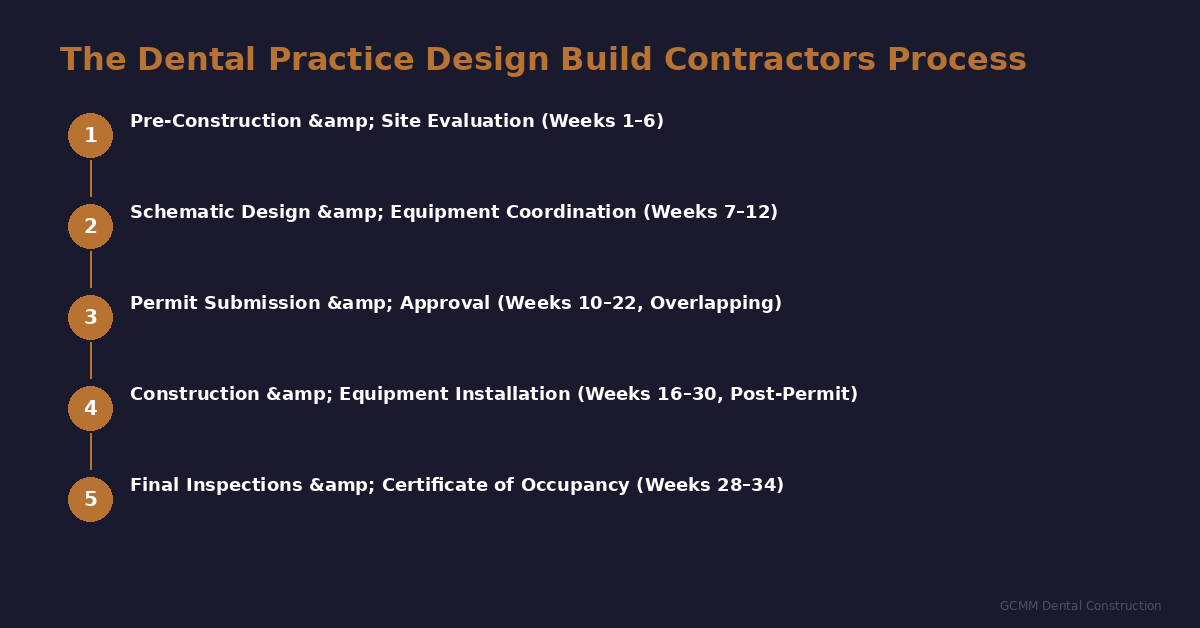
To give you a realistic picture of what the full arc looks like, here’s the typical progression of a Westchester dental office buildout — a three-to-four operatory practice in a vanilla box commercial space, which is the most common scenario we handle.
The Starting Point: A 1,800–2,400 square foot vanilla box in a Westchester commercial corridor — the kind of space you’ll find on Central Park Avenue in Yonkers, along Mamaroneck Avenue in White Plains, or in the medical office parks along Route 119 in Elmsford. The space typically comes with basic electrical service (often 200-amp single-phase, which is insufficient for dental), a single HVAC unit, minimal plumbing, and a commercial ceiling grid. The incoming practice needs three to four operatories with full chair packages, a sterilization center, digital X-ray, a consultation room, staff area, and a reception area designed for patient flow.
Weeks 1–3: Pre-Construction Assessment and Permit Documents. We perform a full MEP assessment of the existing space. The most common red flag: insufficient electrical service. A fully equipped dental office with three-plus operatories, a panoramic X-ray unit, compressor, vacuum, and HVAC typically requires 400-amp three-phase service. If the building only has 200-amp single-phase — which is the case in a large number of older Westchester commercial spaces — a Con Edison service upgrade needs to be coordinated immediately. This single item can add 6–10 weeks to your timeline if it isn’t identified early. Our architect produces stamped drawings covering all disciplines, and we submit to the local building department by the end of Week 3.
Weeks 4–9: Permit Review and Pre-Construction Coordination. Permit review timelines vary significantly across Westchester’s 45 municipalities. Yonkers and White Plains typically take 6–8 weeks; smaller towns like Tarrytown or Ossining can move faster. During the wait, we finalize equipment specifications with you and your dealer, confirm chair package models, delivery unit configurations, and cabinetry selections. We order all long-lead equipment at permit submission — not at permit issuance — which typically shaves three weeks off the equipment delivery wait time. Dental chair packages, panoramic units, and custom cabinetry carry 8–14 week lead times, so early ordering is essential to keeping your project on schedule.
Weeks 9–16: Rough Construction. Demolition of existing finishes and non-structural partitions. New partition framing per permit drawings. Core drilling through concrete slabs for operatory chair utility connections — vacuum, compressed air, water, and electrical. Electrical rough-in including dedicated circuits for each chair package, separate circuits for digital imaging equipment, and a dedicated medical compressor room circuit. Medical-grade compressed air and vacuum rough-in — copper Type K for air lines, Schedule 40 PVC for vacuum evacuation, routed to the mechanical chase per NFPA 99 requirements. New HVAC with dedicated exhaust for the sterilization area. Framing and MEP rough-in inspections coordinated with the local building department.
Weeks 16–21: Finishes and Equipment Installation. Insulation, drywall, tape, and prime. Flooring installation — typically luxury vinyl tile in operatories and clinical areas, with upgraded finishes in reception. Custom millwork delivery and installation. Painting. Then the phase that separates us from general contractors: equipment installation. Our team performs chair package installations, delivery unit connections, and vacuum/air line terminations using exact specifications from the manufacturer’s installation manuals — not approximations, not field improvisation. Because we trained directly with A-dec, Midmark, and Planmeca representatives at Benco Dental, we know the correct rough-in tolerances, connection torque specs, and pressure test requirements from the source. Digital imaging equipment is installed and calibrated. Final inspections scheduled.
Weeks 21–24: Final Inspections and Opening. Building department final inspection, fire marshal sign-off where required, and certificate of occupancy. Equipment commissioning and testing. Staff walkthrough of all systems. The practice opens with zero punchlist items related to equipment connections or utility rough-ins — because the same team that pulled the permits also installed the equipment.
This integrated process is what sets dedicated dental office contractors apart from general commercial firms. When one team handles everything from permits through equipment installation, there’s no finger-pointing between the GC and the equipment installer, no discovering that the rough-in dimensions don’t match the chair specifications, and no expensive re-work after the walls are already closed. If you’d like to see how our approach compares across the full design-build spectrum, our dental practice design-build contractors guide covers the methodology in detail. And for a broader look at how we serve the Westchester region alongside Long Island and NYC, visit our dental practice construction overview page.
Why Westchester Dentists Choose GCMM Dental Construction
Manufacturer-Trained Equipment Installation
We hold training certifications directly from A-dec, Midmark, and Planmeca — the three dominant equipment manufacturers in the dental market. That means we know the correct chair rough-in dimensions, vacuum line sizing specs, and electrical load requirements from the source, not from a brochure.
Westchester Permit Experience
We’ve pulled permits in White Plains, Yonkers, New Rochelle, Greenburgh, Tarrytown, and a dozen other Westchester municipalities. We know which departments require fire marshal review for medical gas, which ones want energy compliance forms at first submission, and how to respond to plan comments without losing weeks.
ADA Compliance Built In
Every scope we write includes ADA accessible route documentation, operatory turning radius compliance, restroom configuration review, and signage requirements. This is standard — not an add-on.
Single Point of Accountability
We manage every trade: framing, electrical, plumbing, HVAC, medical gas, millwork, flooring, and equipment. You have one contact number — (347) 961-7357 — and one team accountable for the entire project.
Realistic Schedules
We don’t sell you a 12-week timeline for a project that takes 20 weeks. We build permit review windows, Con Edison coordination timelines, and equipment lead times into our schedules from day one.
Long-Lead Equipment Pre-Ordering
Dental chair packages, panoramic units, and cabinetry have 8–14 week lead times. We order at permit submission, not at permit issuance, so equipment arrives when construction is ready for it.
Frequently Asked Questions: Dental Office Contractors in Westchester NY
How long does a dental office buildout typically take in Westchester County?
For a standard three-to-four operatory buildout in a vanilla box space, plan for 20–26 weeks from lease execution to opening day in Westchester. That timeline includes 6–10 weeks for architectural drawings and permit review, 10–14 weeks for construction, and 2–3 weeks for equipment installation and commissioning. Municipalities like Yonkers and White Plains tend to run toward the longer end of the permit review window. If your space is in a building that requires a service upgrade from Con Edison, add 6–8 weeks to the electrical portion of the timeline — we start that process at the same time as permit submission to minimize the overlap impact.
Do I need a separate contractor for dental equipment installation, or can the construction contractor handle it?
This is one of the most important questions Westchester dentists ask us, and the honest answer is: it depends entirely on the contractor’s training. Most commercial contractors can frame walls and pull wire, but dental chair packages from A-dec, Midmark, and Planmeca have specific installation requirements — vacuum line slopes, air pressure specifications, electrical circuit configurations — that are documented in manufacturer installation manuals and require hands-on training to execute correctly. We hold manufacturer certifications from all three major brands, which means we handle both the construction rough-in and the equipment installation as a single coordinated scope. That eliminates the finger-pointing that happens when a separate equipment installer finds that the contractor’s rough-in doesn’t match the chair specifications.
What’s the difference between a general contractor and a dental-specific contractor for a Westchester project?
A general commercial contractor can build walls, run conduit, and install finishes. A dental-specific contractor understands infection control zoning, sterilization center workflow, medical gas compliance under NFPA 99, operatory utility rough-in specifications, and digital imaging room requirements — and brings all of that knowledge to the permit drawings, subcontractor coordination, and final inspections. In Westchester, where building departments are increasingly familiar with dental office requirements and will call out non-compliant medical gas installations during inspection, having a contractor who knows these standards in advance is the difference between a smooth project and an expensive re-inspection cycle. Our overview of top dental office contractors covers this distinction in more detail.
Can you work in leased spaces where the landlord has restrictions on modifications?
Yes — and this is actually a common scenario in Westchester, particularly in the county’s suburban medical office parks in Harrison, Purchase, and Ardsley where the buildings are managed by institutional landlords with strict tenant improvement protocols. We routinely work within landlord-required coordination agreements, including approved contractor lists, insurance requirements, MEP coordination with building engineers, and sequenced access schedules. We’ve completed projects in buildings managed by national commercial real estate firms and smaller local landlords alike, and we know how to navigate the approval processes without delaying your construction start. If your lease requires specific contractor qualifications, call us at (347) 961-7357 and we can provide the documentation your landlord needs.
How do you handle ADA compliance for dental offices in older Westchester buildings?
ADA compliance for dental offices involves several overlapping requirements: accessible route from parking or public transit entry through the reception and clinical areas, compliant restroom configuration, operatory door clearances, and signage. In older Westchester buildings — pre-1992 construction in particular — the existing configuration often doesn’t meet current standards, and the question becomes whether the scope of your renovation triggers full compliance upgrades. Under the Americans with Disabilities Act and New York State Building Code, renovation projects that exceed 50% of a building’s replacement value generally trigger full accessibility upgrades. We document the compliance strategy in our permit drawings from the start, working with your architect to determine the correct threshold and produce the equivalent facilitation documentation where full compliance would create a disproportionate cost burden. This keeps your project legally defensible while minimizing unnecessary scope additions. More information on ADA standards is available directly at ADA.gov.
Finding the best dental office contractors in Westchester NY comes down to one thing: choosing a team that knows dental construction specifically — the equipment, the codes, the permit landscape, and the practical realities of building in Westchester’s diverse commercial inventory — not a generalist who’ll figure it out as they go. GCMM Dental Construction has been building dental practices across Westchester County, the Bronx, NYC, Long Island, New Jersey, and Connecticut, and we bring manufacturer-certified equipment installation, ADA-compliant construction standards, and genuine local permit experience to every project we take on. If you’re planning a buildout, a renovation, or even just evaluating a new space and want a realistic feasibility assessment, call us at (347) 961-7357 or email gary@gcmm.nyc. We’re based in the Bronx at 876 Kinsella St and we’re in Westchester regularly — let’s talk about your project.