
Book Appointment Now
Dental Office Plumbing: What Contractors Must Know
Dental Office Plumbing: What Contractors Must Know. Expert insights from GCMM Dental Construction. Call (347) 961-7357 for your project.
Dental Office Plumbing: What Contractors Must Know
Looking for dental office plumbing contractors? Dental office plumbing is not standard commercial plumbing. The systems that serve a modern dental operatory — wet ring connections, central vacuum lines, compressed air distribution, nitrous oxide plumbing, and amalgam separator tie-ins — require a level of technical precision that most general plumbing contractors simply haven’t encountered. At GCMM Dental Construction, we’ve built and renovated dental offices across NYC, Westchester, Long Island, New Jersey, and Connecticut, and we’ve seen firsthand what happens when these systems are roughed in by contractors who treat a dental suite like a restaurant kitchen. The results range from costly rework to failed inspections to equipment that simply won’t function correctly on opening day.
Professional Dental Office Plumbing Contractors
This guide is written for contractors, project managers, and dental practice owners who want to understand exactly what’s involved in dental-specific plumbing — and how dental office contractors who handle specialized plumbing approach these systems differently from standard commercial work.
The Wet Ring Operatory: Foundation of Dental Plumbing Design
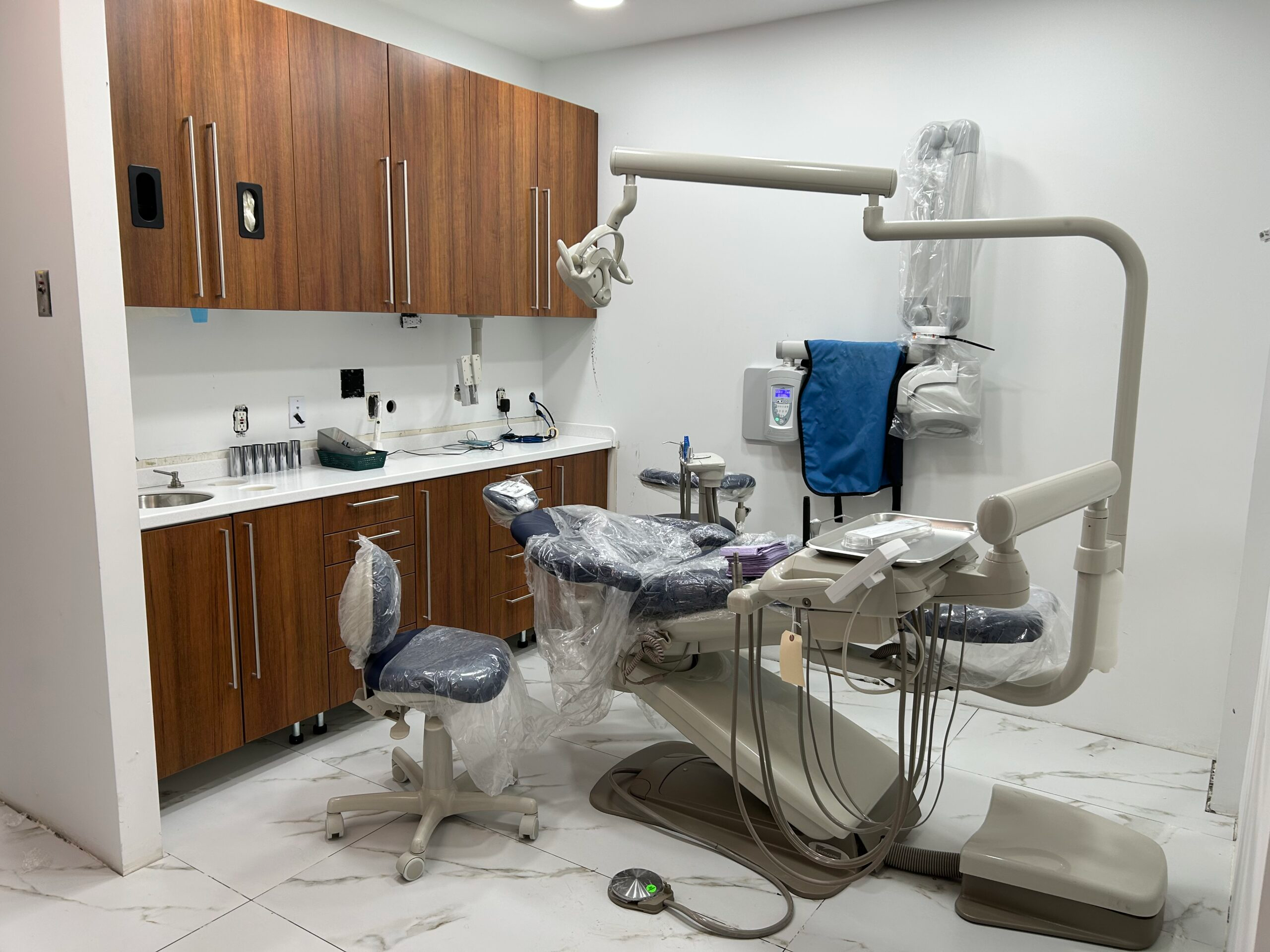
Every dental operatory is built around what the industry calls a “wet ring” — the cluster of utility connections that serve the dental chair and delivery system. A standard wet ring includes a cold water supply line (typically 3/8″ or 1/2″ copper or PEX), a drain line, a vacuum line, and an air supply line. These four rough-ins must be positioned with precision relative to the chair mount location, because chair and delivery unit manufacturers like A-dec, Midmark, and Planmeca specify exact stub-out locations and pressure requirements in their installation manuals.
Our dental office plumbing contractors team specializes in creating functional, code-compliant spaces tailored to your practice.
As an A-dec, Midmark, and Planmeca manufacturer-trained team, we work directly from those installation specs. A Midmark 545 chair, for example, requires the water supply rough-in at a specific height from the finished floor, within a defined horizontal range from the chair base centerline. Miss that rough-in by three inches and you’re looking at exposed supply lines, custom cabinetry modifications, or worse — a flex connection that will kink under the base and restrict flow. These aren’t hypothetical problems. They’re the kinds of issues we’re frequently called in to resolve on jobs where the rough-in was done without consulting the equipment manufacturer’s specifications.
Water supply pressure to a dental unit should be regulated down to between 40 and 80 PSI depending on the manufacturer’s requirements. We install dedicated pressure regulators per operatory, not a single building-wide regulator, because pressure at the equipment needs to be consistent and independently serviceable. A pressure drop during a procedure — caused by simultaneous flushing elsewhere in the building — is unacceptable in a clinical environment.
wp:image {“id”:1224}
/wp:image
Central Vacuum Systems: Sizing, Routing, and Slope Requirements
Central vacuum is one of the most misunderstood systems in dental construction. A dental vacuum system serves two distinct functions: high-volume evacuation (HVE) for the clinical assistant and low-volume saliva ejectors. Both connect back to a central vacuum unit — typically located in a utility room or basement — through a network of PVC or ABS lines that must be sized, sloped, and routed according to precise engineering criteria.
Vacuum line sizing is determined by the number of operatories being served and the type of vacuum unit specified. As a general rule, a 1.5″ trunk line can serve up to two operatories, a 2″ line serves four, and larger practices require 2.5″ or 3″ mains. These lines must maintain a minimum slope of 1/4″ per foot toward the vacuum unit — not toward a drain, as many general plumbers assume. Any low point in a vacuum line becomes a trap for debris and moisture, eventually causing blockages and loss of suction that can shut down clinical operations.
We route vacuum lines above ceiling in most commercial dental buildouts, carefully coordinating with HVAC ductwork and electrical conduit runs. In our New York City projects — where we’re often working in high-rise medical office buildings or multi-tenant commercial spaces — overhead routing requires coordination with the building’s existing infrastructure and the management of sleeve penetrations through fire-rated assemblies. Every penetration must be fire-stopped per local code, and in NYC that means compliance with NYC Building Code Section 717 and the requirements of the specific fire-rated assembly being penetrated.
Compressed Air Distribution for Dental Operatories
Dental air compressors produce oil-free, dry compressed air — a clinical-grade product distinct from the shop air you’d find in an auto body shop or manufacturing facility. The air lines that distribute this compressed air throughout a dental office must be clean, leak-free, and protected from contamination.
We typically use Type L copper for compressed air distribution in dental offices, sweated with lead-free solder throughout. Some practices are moving toward stainless steel or specialized plastic systems, but copper remains the standard in our market. The system is pressure-tested before walls are closed, with a documented hold test — typically 150 PSI for a minimum of two hours — to confirm there are no leaks in the rough-in. This is not optional; it’s a requirement for equipment commissioning by all three manufacturers whose systems our team is trained on.
Compressor room design also matters. The air compressor needs to be isolated from the clinical areas for sound attenuation, needs adequate ventilation to prevent heat buildup, and needs a condensate drain. In our New Jersey and Connecticut projects, we frequently work with local plumbing inspectors to confirm that compressor condensate drainage meets local health department and plumbing code requirements — because dental compressor condensate, while not hazardous, must discharge to a sanitary drain in a code-compliant manner.
wp:image {“id”:1261}
/wp:image
Nitrous Oxide Plumbing: Safety, Code, and Installation Requirements
Nitrous oxide plumbing in a dental office is a medical gas system and must be treated accordingly. In New York, New Jersey, and Connecticut, medical gas piping systems are governed by NFPA 99 (Health Care Facilities Code) and must be installed by contractors specifically qualified for medical gas work. In New York State, this means the work must be performed by or under the direct supervision of a master plumber who holds a medical gas endorsement, and the system must be tested and certified by an independent medical gas verifier before the gas is placed in service.
Nitrous oxide supply lines in dental offices are typically Type K or Type L copper, with brazed (not sweated) connections throughout. Brazing is performed with a nitrogen purge running through the line during the braze — this prevents oxidation on the interior of the tube, which can flake off and contaminate the gas supply or clog equipment. All brazed joints must be documented and accessible for inspection.
Zone valves, pressure alarms, and area alarm panels are required components under NFPA 99, even in small dental practices. The zone valve must be located outside the operatory it serves, so the gas supply can be shut off without entering the room in an emergency. Our team designs the rough-in to accommodate the alarm panel in a staff-accessible location — typically the front office or a central corridor — and coordinates the low-voltage wiring for the panel with the electrical contractor during rough-in.
Scavenging systems are equally important. Nitrous oxide waste gas must be captured and vented to the exterior of the building. Improperly vented or unscavenged systems expose clinical staff to chronic low-level nitrous oxide, which OSHA has linked to reproductive health risks and neurological effects. We route scavenging exhaust lines independently to the exterior, terminating in locations that prevent re-entrainment through HVAC intakes or operable windows.
Amalgam Separator Compliance: NY, NJ, and CT Requirements
The EPA’s Dental Effluent Guidelines (40 CFR Part 441), which took effect in 2020, require virtually all dental practices that handle amalgam to install and maintain an ISO 11143-compliant amalgam separator on the vacuum system drain line. This is federal law, and state environmental agencies in New York, New Jersey, and Connecticut have adopted implementing regulations that add local reporting and compliance requirements on top of the federal baseline.
In New York State, dental practices must submit a one-time compliance report to the EPA and must maintain records of amalgam separator installation, maintenance, and waste disposal. In Connecticut, the DEEP has its own dental amalgam control program with additional documentation requirements. New Jersey follows the federal framework but requires practices to work with licensed hazardous waste handlers for amalgam waste disposal.
From a plumbing standpoint, amalgam separator installation is straightforward but must be done correctly. The separator is installed on the main vacuum drain line — downstream of all operatory connections and upstream of the building sanitary drain. The unit must be accessible for canister changes without requiring tools or the removal of other equipment. We typically build a dedicated utility cabinet or mechanical chase around the separator location, with clearly labeled shutoffs and enough clearance for the canister service interval the practice’s waste contractor specifies.
For our dental plumbing construction projects in New York City specifically, we coordinate amalgam separator compliance with the NYC DEP’s industrial wastewater program, which has its own oversight of dental discharge in some situations. Getting this coordination right during construction — rather than after the practice opens — saves practices from compliance headaches that can result in fines and required retrofits.
wp:image {“id”:1260}
/wp:image
How GCMM Coordinates Plumbing Rough-Ins With Equipment Delivery Schedules
One of the most critical — and most frequently mismanaged — aspects of dental office construction is the sequencing of plumbing rough-ins relative to equipment delivery and installation. Dental equipment lead times are long. A-dec, Midmark, and Planmeca chairs and delivery systems often have 12 to 20-week lead times from order confirmation. That means the equipment must be ordered before construction begins, and the rough-in dimensions must be confirmed from the manufacturer’s submittal drawings — not from memory, not from a previous project’s measurements.
Our process begins with a pre-construction equipment coordination meeting that includes the dental equipment dealer, the plumbing contractor, and our project manager. We review the manufacturer’s rough-in sheets for every piece of equipment — chairs, delivery units, sterilizers, panoramic X-ray units, CBCT machines — and produce a coordinated rough-in drawing that our plumbing subcontractor works from in the field. This drawing is issued as a construction document, not a suggestion.
We also build float into the schedule around equipment delivery. Dental equipment is delivered before walls are closed, because chairs and delivery units cannot be moved through standard door openings after drywall is up. Our schedule accounts for this by maintaining open wall access to the operatory areas until after the equipment has been staged and the final rough-in positions have been confirmed. Only then does our team close walls and proceed with finish work.
Our detailed approach to dental office plumbing has been developed over years of buildouts across the tristate area — from high-rise dental suites in Midtown Manhattan to suburban multi-operatory practices in Westchester County and Northern New Jersey. Every market has its own inspection processes, its own permit timelines, and its own quirks, and our team knows how to navigate all of them.
Frequently Asked Questions
What’s the difference between dental plumbing and standard commercial plumbing?
Dental plumbing includes systems that don’t exist in standard commercial construction: central vacuum, nitrous oxide medical gas, compressed air distribution, and amalgam separator tie-ins. Each system has specific code requirements, manufacturer specifications, and testing protocols that require specialized knowledge to execute correctly.
Do I need a separate contractor for medical gas in a dental office?
In New York, New Jersey, and Connecticut, nitrous oxide piping must be installed by a contractor qualified for medical gas work and certified by an independent verifier before use. We coordinate this scope through our subcontractor network and manage the certification process as part of our overall project delivery.
When should plumbing rough-ins be confirmed for a dental buildout?
Rough-in positions must be confirmed from manufacturer submittal drawings before any plumbing is installed. This requires the equipment to be ordered and the submittals to be reviewed. Attempting to rough in from catalog dimensions or general knowledge is one of the most common and costly mistakes in dental construction.
How does amalgam separator compliance work in New York and New Jersey?
Both states follow the EPA’s federal rule requiring ISO 11143-compliant separators, with additional state-level documentation and reporting. We install separators as part of the plumbing rough-in and help practices understand their ongoing maintenance and reporting obligations.
Work With GCMM Dental Construction
GCMM Dental Construction brings manufacturer-trained expertise to every dental office plumbing project we undertake. From wet ring operatory layouts to nitrous oxide certification to amalgam separator compliance, our team manages the full scope of dental-specific plumbing as part of a coordinated dental office buildout. We serve dental practices across NYC, Westchester, Long Island, New Jersey, and Connecticut.
If you’re planning a new dental office or a multi-operatory renovation and want to work with a team that understands the technical requirements from the ground up, contact us at (347) 961-7357 or email gary@gcmm.nyc. Our office is located at 876 Kinsella St, Bronx, NY, and we’re available to review your project scope, equipment plans, and plumbing requirements before your project breaks ground.
Our team installs and integrates equipment from leading manufacturers including A-dec, ensuring builds operatory rooms to exact equipment specifications. We also provide commercial HVAC contractor through our parent company. Construction standards follow ADA dental office design guidelines.