
Book Appointment Now
CBCT and X-Ray Room Construction: A Contractors Guide
CBCT and X-Ray Room Construction: A Contractors Guide. Expert insights from GCMM Dental Construction. Call (347) 961-7357 for your project.
CBCT and X-Ray Room Construction: A Contractor’s Guide
Looking for cbct x-ray room construction in CB, CT? Building a compliant CBCT or panoramic X-ray room is one of the most technically demanding scopes of work in any dental office construction project. Unlike a standard operatory, an imaging room involves radiation physics, structural engineering, electrical load planning, and multi-agency permit coordination — all before a single patient steps inside. At GCMM Dental Construction, we’ve completed imaging room buildouts across NYC, Westchester, Long Island, New Jersey, and Connecticut, and we’ve seen firsthand what separates a smooth certificate of occupancy from a project that stalls for months over a shielding calculation error.
Professional CBCT X-ray Room Construction in CB, CT
This guide breaks down every major component of CBCT and X-ray room construction — from the initial shielding design to the final inspection sign-off. Whether you’re opening a new practice in the Bronx, retrofitting a suite in Westchester, or adding a CBCT unit to an existing Long Island office, understanding what this work actually involves will help you budget accurately, hire the right contractor, and avoid the costly mistakes we see regularly.
If you’re still in the early stages of planning your full office buildout, our team of Dental Office Contractors NYC & Long Island | GCMM – GCMM Dental Office Construction can help you coordinate imaging room construction alongside every other phase of your project.
Our cbct x-ray room construction team in CB, CT specializes in creating functional, code-compliant spaces tailored to your practice.
Why CBCT Room Construction Requires a Specialist
Cone beam computed tomography (CBCT) units and panoramic X-ray machines are not plug-and-play equipment. Every installation involves ionizing radiation, which means your room must be constructed to meet specific shielding requirements set by your state health department and, in many jurisdictions, reviewed by a licensed medical physicist. In New York State, for example, the Department of Health Bureau of Environmental Radiation Protection (BERP) requires a radiation shielding assessment before equipment installation. Non-compliance isn’t just a permit issue — it’s a liability issue that can result in equipment shutdown, fines, and personal exposure incidents.
Most general contractors are not equipped to handle this work. They don’t understand primary versus secondary radiation barriers, they’re unfamiliar with lead equivalency requirements for different beam energies, and they may not know how to document shielding installations in a format that satisfies a state physicist review. That’s why we specifically position ourselves as Best Dental CBCT & X-Ray Systems: A Contractor’s Installation Guide – GCMM Dental Office Construction — our team is manufacturer-trained on Planmeca systems and works regularly with radiation physicists to produce documentation that passes inspection the first time.
wp:image {“id”:1261}
/wp:image
Radiation Shielding: The Foundation of Every Imaging Room
Radiation shielding design is the first critical step, and it must precede any framing or drywall work. A licensed medical physicist calculates required shielding based on several variables:
- Equipment type and kVp rating: A standard panoramic X-ray operating at 60–90 kVp has different shielding requirements than a CBCT unit running at 85–120 kVp. Higher energy beams require greater lead equivalency.
- Workload (W): How many exposures per week, expressed in milliampere-minutes (mA-min). A busy oral surgery practice running 30+ CBCT scans per week needs heavier shielding than a general dentist doing occasional panoramics.
- Occupancy factor (T): What’s on the other side of each wall? An adjacent waiting room with patients sitting for extended periods requires more protection than a janitor’s closet or exterior wall.
- Use factor (U): The fraction of workload directed at each barrier. Floor and ceiling calculations differ from wall calculations because beam direction varies.
Based on these inputs, the physicist produces a shielding report specifying lead equivalency (typically expressed in millimeters of lead) for each wall, the floor, and the ceiling. Common specifications we see for CBCT rooms in NYC area practices range from 1/16-inch lead (1.6mm) on secondary barriers up to 1/8-inch lead (3.2mm) on primary barriers facing high-occupancy adjacent spaces.
Lead-Lined Drywall vs. Sheet Lead Installation
There are two primary methods for installing radiation shielding in wall assemblies: lead-lined drywall and sheet lead applied to studs.
Lead-lined drywall (typically 5/8″ Type X drywall with a bonded lead sheet) is the most common solution for dental imaging rooms. It’s faster to install, easier to handle, and integrates cleanly with standard drywall finishing. The tradeoff is that seams and penetrations require careful attention — electrical boxes, data conduit, and door frames all create potential gaps in the shielding barrier. Every penetration must be backed with overlapping lead flashing to maintain continuous coverage.
Sheet lead applied directly to studs offers more control over coverage continuity and is sometimes specified when the physicist requires non-standard lead thicknesses not available in pre-fabricated drywall products. Sheet lead (sold by the square foot in specific weights) is stapled or nailed to studs, with seams overlapping by at least 1 inch. Drywall is then installed over it. This method is more labor-intensive and requires a crew experienced in handling and cutting lead safely.
In both cases, door frames, windows, and pass-through openings require lead-lined jambs and, in many designs, a lead acrylic viewing window (typically 1.5–2mm lead equivalency) so the operator can maintain visual contact with the patient without leaving the shielded area.
wp:image {“id”:1260}
/wp:image
Structural Considerations: Floor Load and Room Dimensions
CBCT units are heavy. A Planmeca ProMax 3D Mid, for example, weighs approximately 300–400 lbs for the unit itself, and that load is concentrated on a small base footprint. When you add the weight of lead-lined wall assemblies — which can run 4–6 lbs per square foot — and the equipment base plate or floor-mounted column, floor load becomes a real engineering consideration, particularly in second-story or above-grade installations.
For ground-floor suites with standard concrete slab construction (common in New York City commercial buildings), floor load is rarely a limiting factor. But for practices in multi-story buildings — a common scenario in Manhattan and Westchester commercial corridors — we recommend a structural engineer review before construction begins. We’ve worked on projects where lead shielding added over 2,000 lbs of dead load to a floor system designed for standard commercial occupancy. That requires either engineering sign-off confirming adequate capacity or structural reinforcement.
Minimum room dimensions for CBCT are driven partly by radiation safety geometry and partly by equipment clearance requirements. Most manufacturers specify minimum distances between the X-ray source and walls (often 7–8 feet to the primary barrier) and require adequate patient positioning space. A functional CBCT room typically needs a minimum of 10′ x 10′ clear interior, with 10′ x 12′ being more comfortable for larger units and patient access.
Electrical Requirements: Dedicated Circuits and Power Quality
CBCT and panoramic units are sensitive imaging equipment with specific power requirements. Running them on shared circuits is both a code violation in most jurisdictions and a practical disaster — voltage fluctuations from other equipment on the same circuit can cause image artifacts, calibration errors, and premature component failure.
Standard requirements for CBCT installations we’ve completed include:
- Dedicated 20-amp, 120V circuit for panoramic X-ray units (most require 15–20A at 110–120V)
- Dedicated 20-amp or 30-amp, 120V circuit for CBCT units depending on manufacturer spec — Planmeca units, for example, specify a dedicated 20A circuit with no other loads
- Isolated ground receptacles at the equipment connection point to minimize electrical noise
- Separate circuit for the imaging workstation and monitor to protect sensitive imaging hardware
- Conduit routing that avoids running parallel to shielded walls where penetrations could compromise barrier integrity
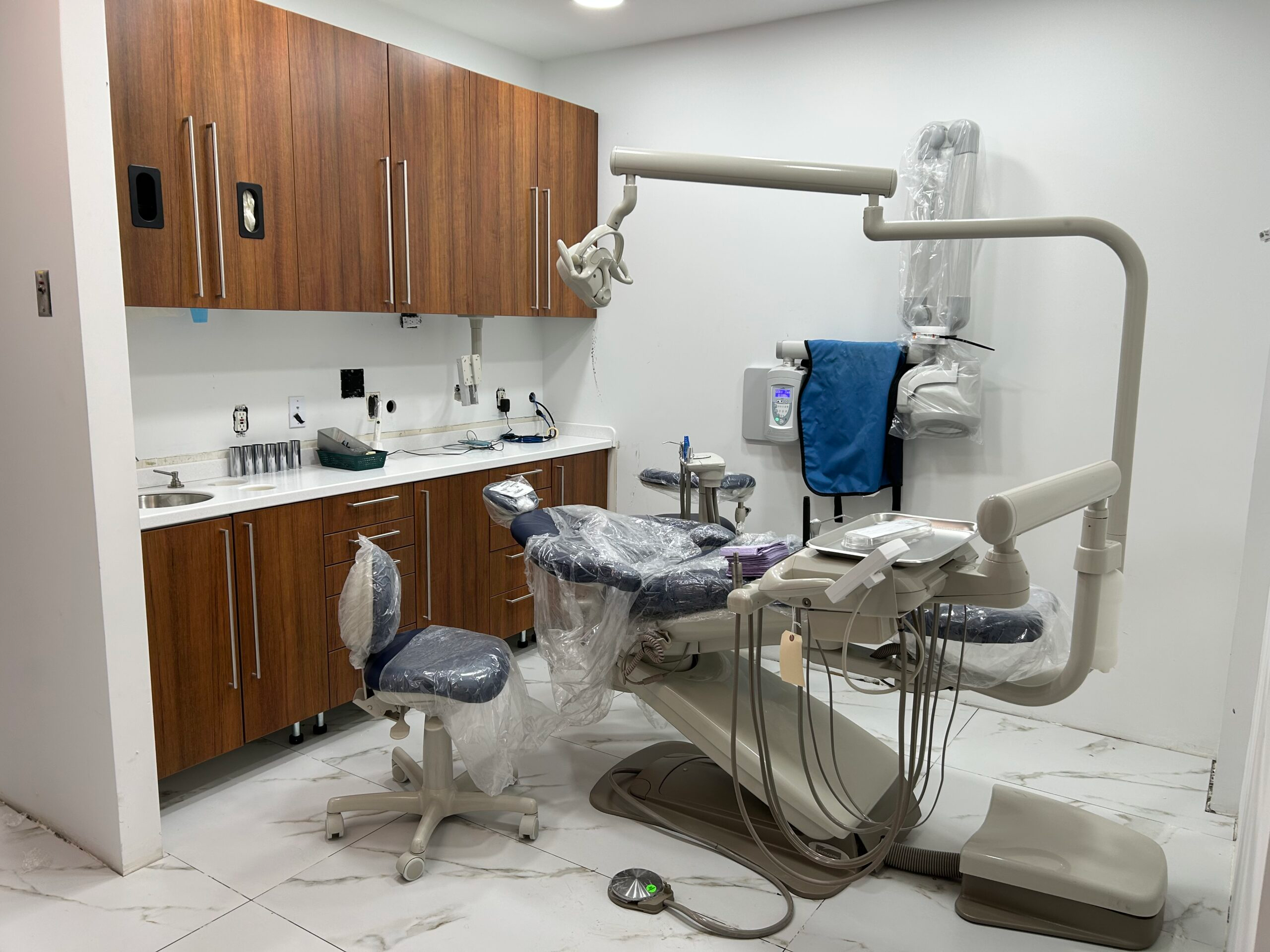
We coordinate directly with the equipment manufacturer’s installation specs during electrical rough-in. This is one area where our manufacturer training on Planmeca systems pays off — we know exactly what the equipment needs before the electrician pulls wire.
wp:image {“id”:1224}
/wp:image
Permit Documentation and the Certificate of Occupancy Process
Imaging room permits involve more agencies and more documentation than a standard tenant improvement. In New York City, you’re typically dealing with the Department of Buildings (DOB) for structural and MEP permits, the Department of Health for X-ray equipment registration, and potentially BERP for radiation use approval depending on equipment classification. In New Jersey and Connecticut, the process differs but the principle is the same — multiple agencies, each with their own submission requirements.
The documents typically required include:
- Architectural drawings showing room dimensions, door locations, and adjacencies
- Shielding design report from a licensed medical physicist, signed and sealed
- Equipment specification sheets (manufacturer documentation of kVp, mA, and beam characteristics)
- X-ray equipment registration application (in NY, filed with the DOH before the unit is energized)
- Electrical permit drawings showing dedicated circuit routing and panel schedule
- Structural engineer letter (if floor load review was required)
Common Errors That Delay Certificate of Occupancy
After completing imaging room projects across the New York metro area, here are the mistakes we see most often when practices hire contractors without specialized dental construction experience:
- Shielding gaps at penetrations: Electrical boxes, conduit sleeves, and HVAC diffuser openings that weren’t backed with lead flashing. The physicist’s field survey catches these, and remediation after drywall is already installed is expensive and time-consuming.
- Lead-lined drywall installed without seam overlap: Butt joints between lead-lined panels must overlap or be backed with a lead strip. Contractors unfamiliar with radiation shielding sometimes treat it like standard drywall installation.
- Incorrect door specification: Standard hollow-core doors provide essentially zero radiation shielding. Lead-lined door assemblies must be specified and ordered early — they’re typically 6–8 week lead items.
- Equipment registration filed too late: In New York, the X-ray equipment registration must be filed before the unit can be used clinically. Practices that don’t start this process during construction end up with installed equipment they can’t legally operate while paperwork catches up.
- No physicist field survey: Some contractors skip the final field survey step. Without written sign-off from the physicist confirming the as-built shielding matches the design, the health department won’t issue operating approval.
Real Cost Ranges for CBCT Room Construction
Cost varies significantly based on room size, existing conditions, shielding requirements, and local labor markets. Based on projects we’ve completed across NYC, Long Island, and Westchester, here are realistic ranges:
- Medical physicist shielding report: $800–$2,500 depending on complexity and number of rooms
- Lead-lined drywall and installation (complete room): $4,000–$9,000
- Lead-lined door assembly (supply and install): $2,500–$5,000
- Dedicated electrical circuits and panel work: $1,500–$3,500
- Permit fees (NYC as reference): $1,000–$3,000+ depending on scope
- Full CBCT room buildout (construction only, not equipment): $18,000–$45,000 depending on existing conditions and finish level
These figures reflect new construction or significant renovation. Retrofitting an existing room in an occupied building — which requires coordinating lead waste disposal, working around a functioning practice, and potentially working nights or weekends — will add 20–35% to labor costs in many cases.
Working With GCMM Dental Construction on Your Imaging Room
At GCMM Dental Construction, we’ve built our reputation as specialized dental office contractors for imaging rooms across the New York metro area. Our team coordinates every phase of imaging room construction — from the initial physicist engagement and permit documentation through shielding installation, electrical rough-in, equipment coordination, and final inspection. We’re manufacturer-trained on Planmeca systems, which means we understand the equipment before construction begins, not after.
We work with practices opening new locations, dentists expanding into CBCT imaging for the first time, and oral surgery groups upgrading older panoramic installations across NYC, Westchester, Long Island, New Jersey, and Connecticut. To learn more about our full-service approach, visit our About Us – GCMM Dental Office Construction page or browse our Blog | Expert Dental Construction Insights & Tips – GCMM Dental Office Construction for additional technical guides on dental office construction topics.
If you’re planning a CBCT room and want to talk through your specific space, equipment, and timeline, reach out to our team directly. We’ll give you a straightforward assessment of what the project involves — no generic estimates, no surprises.
Call us at (347) 961-7357 or email gary@gcmm.nyc. Our office is located at 876 Kinsella St, Bronx, NY, and we serve practices throughout NYC, Westchester, Long Island, New Jersey, and Connecticut.
Frequently Asked Questions
Do I need a medical physicist for a panoramic X-ray room, or just for CBCT?
In most jurisdictions, including New York, a physicist shielding evaluation is required for any room housing ionizing radiation equipment — including panoramic X-ray units. The specific regulatory requirement varies by state, but even where it’s not legally mandated, we recommend a physicist review for every imaging room. The cost of a shielding report ($800–$2,500) is trivial compared to the cost of reopening walls to correct inadequate shielding after the fact.
How long does a CBCT room buildout typically take?
For a new construction or full renovation scenario, a CBCT room typically takes 6–10 weeks from permit approval to certificate of occupancy. The critical path items are the shielding design report (which must precede framing), lead-lined door procurement (6–8 week lead time), and equipment registration paperwork. On projects where we’re coordinating the full dental office buildout, we sequence the imaging room early precisely because of these long-lead items.
Can my general contractor handle this, or do I need a specialist?
A general contractor without dental construction experience will typically struggle with the regulatory documentation, shielding installation details, and equipment coordination involved in an imaging room buildout. We’ve corrected work from general contractors who installed lead-lined drywall without proper penetration protection, omitted lead-lined door assemblies, or skipped the physicist field survey entirely. The rework costs in those cases exceeded what a specialist would have charged to do the project correctly the first time.
Does lead construction waste require special disposal?
Yes. Lead is a regulated hazardous material, and lead-lined drywall cutoffs, sheet lead scraps, and lead flashing trimmings must be disposed of through a licensed hazardous waste contractor. This is a cost and logistical consideration that some contractors fail to account for in their proposals. We include proper lead waste handling and disposal in our imaging room scopes as a standard line item.
With factory certification from A-dec, our team builds operatory rooms to exact equipment specifications. GCMM also offers commercial HVAC contractor for non-dental commercial projects. All work meets ADA dental office design guidelines.